
Pearson+ LogoPearson+ Logo
Ch. 54 - Biodiversity and Conservation Ecology
Freeman - Biological Science 8th Edition
Freeman8th EditionBiological ScienceISBN: 9780138276263Not the one you use?Change textbook
Chapter 54, Problem 14

Do you drink coffee? A lot of people do—coffee is a major tropical crop, valued at over \$100 billion per year. The most popular species of coffee, Coffea arabica, originated in Africa and is now planted extensively in Central and South America. The pest called the coffee berry borer beetle (Hypothenemus hampeii) moved along with the coffee and is a major problem for coffee farmers, sometimes destroying half of the coffee crop in mature plantations. The abundance of birds and other predators of borer beetles depends on how much natural forest is left within and around the coffee plantations. What is the approximate percentage increase in borer predators per hectare if forest cover is doubled from 15 to 30 percent?

Verified step by step guidance
1
Identify the data points for 15% and 30% forest cover on the graph.
Read the corresponding values of borer predators per hectare for these forest cover percentages.
Calculate the difference in the number of borer predators per hectare between 15% and 30% forest cover.
Determine the percentage increase using the formula: \( \text{Percentage Increase} = \frac{\text{New Value} - \text{Old Value}}{\text{Old Value}} \times 100 \).
Substitute the values obtained from the graph into the formula to find the approximate percentage increase.

Verified video answer for a similar problem:

This video solution was recommended by our tutors as helpful for the problem above.
Video duration:
1m
Was this helpful?

Key Concepts

Here are the essential concepts you must grasp in order to answer the question correctly.

Forest Cover and Biodiversity

Forest cover refers to the percentage of land area that is covered by forests. Increased forest cover is associated with higher biodiversity, as forests provide habitat for various species, including predators of pests like the coffee berry borer beetle. This relationship is crucial for maintaining ecological balance and supporting agricultural productivity.
Recommended video:
Guided course
01:03
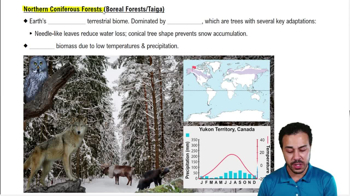
Northern Coniferous Forests (Boreal Forests/Taiga)

Predator-Prey Dynamics

Predator-prey dynamics describe the interactions between predators and their prey within an ecosystem. In the context of coffee plantations, the presence of predators that feed on the coffee berry borer beetle can help control its population, thereby reducing crop damage. Understanding these dynamics is essential for effective pest management strategies in agriculture.
Recommended video:
Guided course
03:01
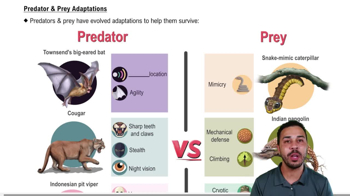
Predator & Prey Adaptations

Data Interpretation and Linear Relationships

Data interpretation involves analyzing graphical representations of data to identify trends and relationships. The provided graph shows a linear relationship between forest cover percentage and the number of borer predators per hectare. By understanding this relationship, one can estimate the impact of changes in forest cover on predator populations, which is vital for making informed agricultural decisions.
Recommended video:
Guided course
02:47
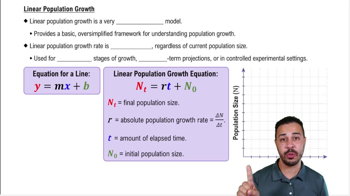
Linear Population Growth
Related Practice
Textbook Question

Do you drink coffee? A lot of people do—coffee is a major tropical crop, valued at over \$100 billion per year. The most popular species of coffee, Coffea arabica, originated in Africa and is now planted extensively in Central and South America. The pest called the coffee berry borer beetle (Hypothenemus hampeii) moved along with the coffee and is a major problem for coffee farmers, sometimes destroying half of the coffee crop in mature plantations.

Based on what you have learned in this chapter about global trends in terrestrial ecosystems, what is currently the largest threat to the wet tropical forests in Central America?

a. Habitat destruction, such as the clearing of forests for coffee plantations

b. Exotic species, such as the introduction of coffee berry borers

c. Pollution, such as the use of pesticides in coffee plantations

d. Climate change, such as changes in precipitation patterns

Textbook Question

Do you drink coffee? A lot of people do—coffee is a major tropical crop, valued at over \$100 billion per year. The most popular species of coffee, Coffea arabica, originated in Africa and is now planted extensively in Central and South America. The pest called the coffee berry borer beetle (Hypothenemus hampeii) moved along with the coffee and is a major problem for coffee farmers, sometimes destroying half of the coffee crop in mature plantations.

Pesticides are generally ineffective in killing coffee berry borers. Ecologist Daniel Karp and colleagues conducted a study in Costa Rica to determine if natural predators like birds reduce the beetle population. The researchers selected 12 control plots and used nets to exclude birds from 12 similar treatment plots. What is the take-home message of the graph? (Remember, * means P < 6 0.05)

Textbook Question

Do you drink coffee? A lot of people do—coffee is a major tropical crop, valued at over \$100 billion per year. The most popular species of coffee, Coffea arabica, originated in Africa and is now planted extensively in Central and South America. The pest called the coffee berry borer beetle (Hypothenemus hampeii) moved along with the coffee and is a major problem for coffee farmers, sometimes destroying half of the coffee crop in mature plantations.

Look at the graph. Why did the researchers bother to collect data from the coffee shrubs before adding the nets to treatment plots to exclude birds?

Textbook Question

Do you drink coffee? A lot of people do—coffee is a major tropical crop, valued at over \$100 billion per year. The most popular species of coffee, Coffea arabica, originated in Africa and is now planted extensively in Central and South America. The pest called the coffee berry borer beetle (Hypothenemus hampeii) moved along with the coffee and is a major problem for coffee farmers, sometimes destroying half of the coffee crop in mature plantations. Draw a simple model to compare the relative species richness and species diversity of these two coffee plantations: one is clear-cut and planted with only coffee shrubs, the other retains some natural forest. For symbols, use a few letters to represent different species of plants and a few numbers to represent different species of animals in a square 1-ha plot.

2
views
Textbook Question

Do you drink coffee? A lot of people do—coffee is a major tropical crop, valued at over \$100 billion per year. The most popular species of coffee, Coffea arabica, originated in Africa and is now planted extensively in Central and South America. The pest called the coffee berry borer beetle (Hypothenemus hampeii) moved along with the coffee and is a major problem for coffee farmers, sometimes destroying half of the coffee crop in mature plantations. Evaluate this statement: Leaving some natural forest in and around coffee plantations is a 'win-win' situation—a win for ecosystems and a win for farmers.

2
views