Pose a hypothesis to explain why the human population has undergone especially rapid growth over the past 200 years. Describe two examples of density-dependent factors that limit human population growth. Is it possible that humans have surpassed Earth's carrying capacity?
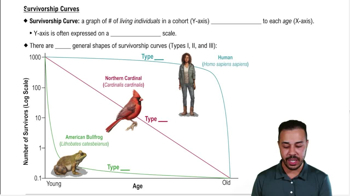
Which of the following species is most likely to have a Type III survivorship curve?
a. Humans, Homo sapiens
b. Common lizards, Zootoca vivipara
c. Thale cress plants, Arabidopsis thaliana
d. Lynx cats, Lynx canadensis
Verified step by step guidance
Verified video answer for a similar problem:
Key Concepts
Survivorship Curves
Type III Survivorship Curve
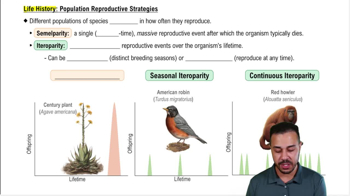
Life History Strategies
In what populations does exponential growth tend to occur?
a. Populations that colonize new habitats
b. Populations that experience intense competition
c. Populations that experience high rates of predation
d. Populations that have surpassed their carrying capacity
If most individuals in a population are young, why is the population likely to grow rapidly in the future?
a. Death rates will be low.
b. The population has a skewed age distribution.
c. Immigration and emigration can be ignored.
d. Many individuals will begin to reproduce soon.
Why is there a trade-off between survivorship and fecundity?
Explain why biologists want to maintain (a) 'habitat corridors' that connect populations in a metapopulation, and (b) unoccupied habitat that is appropriate for the species in question.
Indicate what is correct and incorrect about this statement: If lizards want to survive during climate change, they can evolve new life-history traits.
