Pearson+ LogoPearson+ Logo
Ch. 51 - Population Ecology
Freeman - Biological Science 8th Edition
Freeman8th EditionBiological ScienceISBN: 9780138276263Not the one you use?Change textbook
Chapter 51, Problem 2

In what populations does exponential growth tend to occur?
a. Populations that colonize new habitats
b. Populations that experience intense competition
c. Populations that experience high rates of predation
d. Populations that have surpassed their carrying capacity

Verified step by step guidance
1
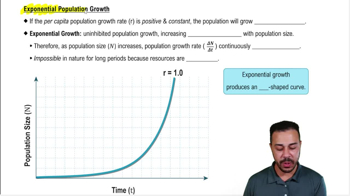
Understand the concept of exponential growth: Exponential growth occurs when the resources available to a population are abundant, allowing the population to grow at a constant rate per time period. This type of growth is characterized by a J-shaped curve when population size is plotted over time.
Consider the conditions necessary for exponential growth: For a population to grow exponentially, it must have access to unlimited resources, minimal competition, and low predation pressure. These conditions allow the population to reproduce at its maximum rate.
Analyze each option: a. Populations that colonize new habitats often experience exponential growth because they encounter abundant resources and little competition initially. b. Populations experiencing intense competition are unlikely to grow exponentially as resources are limited. c. Populations with high predation rates face increased mortality, hindering exponential growth. d. Populations that have surpassed their carrying capacity will experience resource scarcity, preventing exponential growth.
Identify the correct scenario: Exponential growth is most likely to occur in populations that colonize new habitats (option a), where they initially face minimal competition and have abundant resources.
Conclude with the reasoning: Populations in new habitats can grow rapidly until they start to face limitations such as resource depletion or increased competition, at which point the growth rate will slow down and may transition to logistic growth.

Verified video answer for a similar problem:

This video solution was recommended by our tutors as helpful for the problem above.
Video duration:
1m
Was this helpful?

Key Concepts

Here are the essential concepts you must grasp in order to answer the question correctly.

Exponential Growth

Exponential growth occurs when the resources available to a population are abundant, allowing the population size to increase rapidly without any significant constraints. This type of growth is characterized by a constant rate of growth per unit time, leading to a J-shaped curve when population size is plotted over time. It is typically observed in populations that are introduced to a new environment with plentiful resources.
Recommended video:
Guided course
03:05
Exponential Population Growth

Carrying Capacity

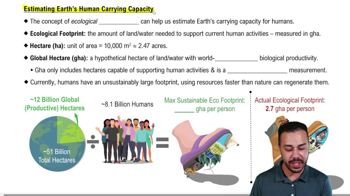
Carrying capacity refers to the maximum number of individuals of a species that an environment can sustainably support over time without degrading the environment. It is determined by the availability of resources such as food, water, and space, as well as environmental conditions. When a population exceeds its carrying capacity, resources become limited, leading to competition and a potential decline in population size.
Recommended video:
Guided course
06:24
Estimating Earth’s Human Carrying Capacity

Colonization of New Habitats

When a population colonizes a new habitat, it often experiences exponential growth due to the lack of competition and predators, and the abundance of resources. This initial phase of rapid growth is possible because the new environment provides ample opportunities for reproduction and survival, allowing the population to expand quickly until it approaches the carrying capacity of the habitat.
Recommended video:
Guided course
03:23
Habitat Destruction and Degradation