

Ch. 48 - The Immune System in Animals
Freeman8th EditionBiological ScienceISBN: 9780138276263
Not the one you use?Change textbookSelect a different textbook
Table of contents
- Ch. 1 - Biology: The Study of Life13
- Ch. 2 - Water and Carbon: The Chemical Basis of Life14
- Ch.3 - Protein Structure and Function10
- Ch.4 - Nucleic Acids and the RNA World10
- Ch. 5 - An Introduction to Carbohydrates10
- Ch. 6 - Lipids, Membranes, and the First Cells11
- Ch. 7 - Inside the Cell10
- Ch. 8 - Energy and Enzymes: An Introduction to Metabolism10
- Ch. 9 - Cellular Respiration and Fermentation11
- Ch. 10 - Photosynthesis12
- Ch. 11 - Cell-Cell Interactions12
- Ch. 12 - The Cell Cycle8
- Ch. 13 - Meiosis12
- Ch. 14 - Mendel and the Gene23
- Ch. 15 - DNA and the Gene: Synthesis and Repair15
- Ch. 16 - How Genes Work16
- Ch. 17 - Transcription, RNA Processing, and Translation16
- Ch. 18 - Control of Gene Expression in Bacteria16
- Ch. 19 - Control of Gene Expression in Eukaryotes12
- Ch. 20 - The Molecular Revolution: Biotechnology, Genomics, and New Frontiers15
- Ch. 21 - Genes, Development, and Evolution12
- Ch. 22 - Evolution by Natural Selection16
- Ch. 23 - Evolutionary Processes13
- Ch. 24 - Speciation15
- Ch. 25 - Phylogenies and the History of Life13
- Ch. 26 - Bacteria and Archaea15
- Ch. 27 - Diversification of Eukaryotes16
- Ch. 28 - Green Algae and Land Plants16
- Ch. 29 - Fungi18
- Ch. 30 - An Introduction to Animals9
- Ch. 31 - Protostome Animals15
- Ch. 32 - Deuterostome Animals17
- Ch. 33 - Viruses16
- Ch. 34 - Plant Form and Function16
- Ch. 35 - Water and Sugar Transport in Plants16
- Ch. 36 - Plant Nutrition13
- Ch. 37 - Plant Sensory Systems, Signals, and Responses16
- Ch. 38 - Flowering Plant Reproduction and Development16
- Ch. 39 - Animal Form and Function17
- Ch. 40 - Water and Electrolyte Balance in Animals16
- Ch. 41 - Animal Nutrition16
- Ch. 42 - Gas Exchange and Circulation16
- Ch. 43 - Animal Nervous Systems16
- Ch. 44 - Animal Sensory Systems16
- Ch. 45 - Animal Movement11
- Ch. 46 - Chemical Signals in Animals16
- Ch. 47 - Animal Reproduction and Development16
- Ch. 48 - The Immune System in Animals16
- Ch. 49 - An Introduction to Ecology15
- Ch. 50 - Behavioral Ecology16
- Ch. 51 - Population Ecology16
- Ch. 52 - Community Ecology20
- Ch. 53 - Ecosystems and Global Ecology17
- Ch. 54 - Biodiversity and Conservation Ecology18

Chapter 48, Problem 15
Lipid nanoparticle formulations of self-amplifying RNA contain lipids, phospholipids, and cholesterol (for review, see Ch. 7, Section 7.5). By which process do they enter cells?
a. beating cilia
b. phagocytosis
c. receptor-mediated endocytosis
d. macropinocytosis
 Verified step by step guidance
1
Identify the components of the lipid nanoparticle formulations mentioned in the question: lipids, phospholipids, and cholesterol.
Understand the nature of lipid nanoparticles and their interaction with cell membranes, which are also composed of lipid bilayers.
Review the listed cellular processes to determine which is most likely involved in the internalization of lipid-based particles. The processes listed are: beating cilia, phagocytosis, receptor-mediated endocytosis, and macropinocytosis.
Consider the specificity and mechanism of receptor-mediated endocytosis, which involves the cell surface receptors binding to specific molecules (ligands), leading to the formation of vesicles that internalize the ligand-receptor complexes.
Evaluate how the lipid composition of the nanoparticles might interact with cell membrane receptors to facilitate entry into cells via receptor-mediated endocytosis.
Key Concepts
Here are the essential concepts you must grasp in order to answer the question correctly.
Lipid Nanoparticles
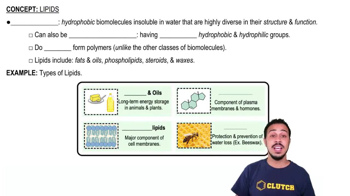
Lipid nanoparticles (LNPs) are small lipid-based carriers that encapsulate nucleic acids, such as RNA, to facilitate their delivery into cells. They are composed of lipids, phospholipids, and cholesterol, which help stabilize the RNA and enhance cellular uptake. LNPs are particularly important in mRNA vaccine technology, as they protect the RNA from degradation and promote efficient delivery to target cells.
Recommended video:
Guided course
 04:19
04:19
Lipids
Endocytosis
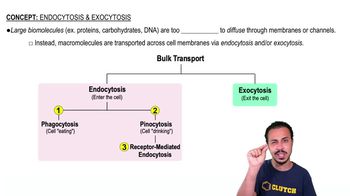
Endocytosis is a cellular process in which substances are brought into the cell by engulfing them in a membrane-bound vesicle. This process is crucial for the uptake of large molecules, such as RNA encapsulated in lipid nanoparticles. There are various forms of endocytosis, including receptor-mediated endocytosis, which is highly specific and involves the binding of ligands to cell surface receptors.
Recommended video:
Guided course
 02:02
02:02Endocytosis and Exocytosis
Receptor-Mediated Endocytosis
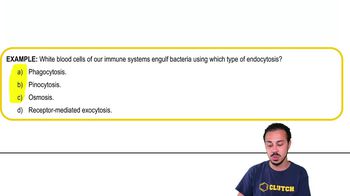
Receptor-mediated endocytosis is a selective process where cells internalize specific molecules based on their recognition by cell surface receptors. This mechanism allows for the efficient uptake of nutrients, hormones, and other signaling molecules. In the context of lipid nanoparticles, this process enables the targeted delivery of RNA to cells, enhancing the effectiveness of therapies such as vaccines.
Recommended video:
Guided course
 01:52
01:52Endocytosis and Exocytosis Example 1
Related Practice