Pearson+ LogoPearson+ Logo
Ch. 45 - Animal Movement
Freeman - Biological Science 8th Edition
Freeman8th EditionBiological ScienceISBN: 9780138276263Not the one you use?Change textbook
Chapter 45, Problem 12

In 2023, Tigist Assefa of Ethiopia set a new record with a time of 2 hours, 11 minutes, and 53 seconds. Scientists, trainers, and athletes alike have wondered about the extent to which muscle structure and function contribute to success in athletes such as Assefa. What makes elite distance runners so good? Are their muscles somehow different from those of less successful athletes and non-athletes? Predict who would likely have a greater proportion of fast glycolytic fibers in their gastrocnemius (calf) muscle—an elite distance runner or an elite sprinter. Explain.

Verified step by step guidance
1
Understand the types of muscle fibers: There are primarily two types of muscle fibers relevant to this discussion—slow oxidative fibers and fast glycolytic fibers. Slow oxidative fibers are more efficient at using oxygen to generate more ATP for continuous, extended muscle contractions over a long time. In contrast, fast glycolytic fibers are better at generating short bursts of strength or speed but fatigue more quickly.
Relate muscle fiber types to athletic performance: Elite distance runners, like Tigist Assefa, typically excel in activities that require endurance and stamina. These activities primarily utilize slow oxidative fibers, which are crucial for long-duration aerobic activities that require energy over extended periods.
Consider the characteristics of fast glycolytic fibers: Fast glycolytic fibers, on the other hand, are characterized by their ability to generate quick, powerful bursts of speed and force. These fibers fatigue quickly and are anaerobic, meaning they do not rely on oxygen for fuel.
Compare the muscle demands of different athletic events: Sprinting requires rapid, intense bursts of speed, which depend heavily on fast glycolytic fibers. These fibers provide the explosive power necessary for short, high-intensity activities typical of sprinting.
Predict the muscle fiber composition: Given the demands of their respective sports, an elite sprinter would likely have a greater proportion of fast glycolytic fibers in their gastrocnemius muscle compared to an elite distance runner. The sprinter's performance relies more on speed and power, which are characteristics of fast glycolytic fibers.

Verified video answer for a similar problem:

This video solution was recommended by our tutors as helpful for the problem above.
Video duration:
2m
Was this helpful?

Key Concepts

Here are the essential concepts you must grasp in order to answer the question correctly.

Muscle Fiber Types

Muscle fibers are categorized into three main types: slow-twitch (Type I), fast-twitch (Type IIa), and fast-twitch (Type IIb). Slow-twitch fibers are more efficient for endurance activities, utilizing oxygen for energy, while fast-twitch fibers are geared towards short bursts of power and speed, relying on anaerobic metabolism. Elite distance runners typically have a higher proportion of slow-twitch fibers, which support sustained aerobic activity, whereas sprinters possess more fast-twitch fibers for explosive strength.
Recommended video:
Guided course
02:40
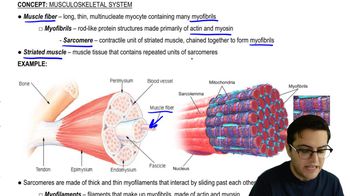
Muscle Fibers and Sarcomeres

Gastrocnemius Muscle Function

The gastrocnemius is a major muscle in the calf that plays a crucial role in running and jumping. It is involved in plantar flexion of the foot, which is essential for pushing off the ground during running. The composition of muscle fibers within the gastrocnemius can influence an athlete's performance; sprinters benefit from a higher proportion of fast-twitch fibers for rapid acceleration, while distance runners rely on the endurance capabilities of slow-twitch fibers.
Recommended video:
Guided course
06:04
Functional Groups

Physiological Adaptations to Training

Athletes undergo physiological adaptations based on their training regimens, which can alter muscle fiber composition and function. Endurance training typically enhances the oxidative capacity of slow-twitch fibers, improving stamina and efficiency in distance running. In contrast, sprint training increases the size and power of fast-twitch fibers, allowing for greater force production in short, intense efforts. These adaptations are key in distinguishing the performance capabilities of elite distance runners versus sprinters.
Recommended video:
Guided course
05:13
Heart Physiology
Related Practice
Textbook Question

How did data on sarcomere structure inspire the sliding-filament model of muscle contraction?

Explain why the observation that muscle cells contain many mitochondria and extensive smooth endoplasmic reticulum turned out to be logical once the molecular mechanism of muscular contraction was understood.

Textbook Question

Rigor mortis is the stiffening of a body after death that occurs when myosin binds to actin but cannot unbind. What prevents myosin from unbinding?

Textbook Question

In 2023, Tigist Assefa of Ethiopia set a new record with a time of 2 hours, 11 minutes, and 53 seconds. Scientists, trainers, and athletes alike have wondered about the extent to which muscle structure and function contribute to success in athletes such as Assefa. What makes elite distance runners so good? Are their muscles somehow different from those of less successful athletes and non-athletes? Compare and contrast the structure and function of the three types of skeletal muscle fibers.

Textbook Question

In 2023, Tigist Assefa of Ethiopia set a new record with a time of 2 hours, 11 minutes, and 53 seconds. Scientists, trainers, and athletes alike have wondered about the extent to which muscle structure and function contribute to success in athletes such as Assefa. What makes elite distance runners so good? Are their muscles somehow different from those of less successful athletes and non-athletes? Predict the effect of training for a marathon on the number of muscle cells in the gastrocnemius. Explain.

Textbook Question

In 2023, Tigist Assefa of Ethiopia set a new record with a time of 2 hours, 11 minutes, and 53 seconds. Scientists, trainers, and athletes alike have wondered about the extent to which muscle structure and function contribute to success in athletes such as Assefa. What makes elite distance runners so good? Are their muscles somehow different from those of less successful athletes and non-athletes? To discover the relationship between muscle-fiber types and performance, researchers obtained tiny biopsies of the gastrocnemius of 14 elite distance runners, 18 trained but non-elite distance runners, and 19 untrained subjects. They categorized the fiber types as slow or fast. (At the time of the study, intermediate fibers had not been identified as a third type.) Some of their data are shown here (* means 𝑃<0.05; BioSkills 3). What conclusions can you draw from these data?


Textbook Question

In 2023, Tigist Assefa of Ethiopia set a new record with a time of 2 hours, 11 minutes, and 53 seconds. Scientists, trainers, and athletes alike have wondered about the extent to which muscle structure and function contribute to success in athletes such as Assefa. What makes elite distance runners so good? Are their muscles somehow different from those of less successful athletes and non-athletes? The researchers looked more closely at the data within the group of elite runners. Although the mean proportion of slow fibers was 79 percent in this group, individual values ranged from 27 percent in one runner to 98 percent in another. How does this finding affect your interpretation of the relationship between athletic performance and muscle-fiber types?