Pearson+ LogoPearson+ Logo
Ch. 45 - Animal Movement
Freeman - Biological Science 8th Edition
Freeman8th EditionBiological ScienceISBN: 9780138276263Not the one you use?Change textbook
Chapter 45, Problem 14

In 2023, Tigist Assefa of Ethiopia set a new record with a time of 2 hours, 11 minutes, and 53 seconds. Scientists, trainers, and athletes alike have wondered about the extent to which muscle structure and function contribute to success in athletes such as Assefa. What makes elite distance runners so good? Are their muscles somehow different from those of less successful athletes and non-athletes? To discover the relationship between muscle-fiber types and performance, researchers obtained tiny biopsies of the gastrocnemius of 14 elite distance runners, 18 trained but non-elite distance runners, and 19 untrained subjects. They categorized the fiber types as slow or fast. (At the time of the study, intermediate fibers had not been identified as a third type.) Some of their data are shown here (* means 𝑃<0.05; BioSkills 3). What conclusions can you draw from these data?


Verified step by step guidance
1
Examine the bar graph to understand the distribution of slow muscle fibers among elite runners, non-elite runners, and untrained subjects.
Note the y-axis, which represents the percentage of slow fibers, and the x-axis, which categorizes the subjects into elite runners, non-elite runners, and untrained subjects.
Observe that elite runners have the highest percentage of slow fibers, followed by non-elite runners, and then untrained subjects.
Identify the asterisks (*) above the bars, which indicate statistically significant differences (P < 0.05) between the groups.
Conclude that a higher percentage of slow muscle fibers is associated with elite distance running performance, suggesting that muscle fiber composition plays a role in athletic success.

Verified video answer for a similar problem:

This video solution was recommended by our tutors as helpful for the problem above.
Video duration:
3m
Was this helpful?

Key Concepts

Here are the essential concepts you must grasp in order to answer the question correctly.

Muscle Fiber Types

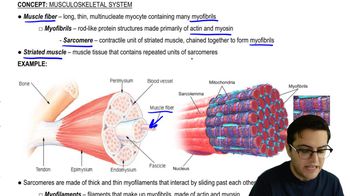
Muscle fibers are categorized into two main types: slow-twitch (Type I) and fast-twitch (Type II). Slow-twitch fibers are more efficient for endurance activities, as they use oxygen to generate energy and are resistant to fatigue. In contrast, fast-twitch fibers are geared towards short bursts of speed and power but fatigue quickly. The distribution of these fiber types can significantly influence an athlete's performance in endurance sports.
Recommended video:
Guided course
02:40
Muscle Fibers and Sarcomeres

Gastrocnemius Muscle

The gastrocnemius is a major muscle in the calf that plays a crucial role in running and other athletic activities. It is composed of both slow-twitch and fast-twitch fibers, which contribute to its function in generating force and facilitating movement. Understanding the composition of this muscle in elite versus non-elite runners can provide insights into their performance capabilities and endurance.
Recommended video:
Guided course
02:08
Muscle System and Skeleton

Statistical Significance in Research

Statistical significance is a measure that helps determine whether the results of a study are likely due to chance or represent a true effect. In the context of the provided data, a p-value of less than 0.05 (indicated by *) suggests that the differences observed in muscle fiber composition among elite, non-elite, and untrained subjects are statistically significant. This means that the variations in slow-twitch fiber percentages are likely meaningful in understanding athletic performance.
Recommended video:
Guided course
01:56
Demography and Life Tables
Related Practice
Textbook Question

In 2023, Tigist Assefa of Ethiopia set a new record with a time of 2 hours, 11 minutes, and 53 seconds. Scientists, trainers, and athletes alike have wondered about the extent to which muscle structure and function contribute to success in athletes such as Assefa. What makes elite distance runners so good? Are their muscles somehow different from those of less successful athletes and non-athletes? Compare and contrast the structure and function of the three types of skeletal muscle fibers.

Textbook Question

In 2023, Tigist Assefa of Ethiopia set a new record with a time of 2 hours, 11 minutes, and 53 seconds. Scientists, trainers, and athletes alike have wondered about the extent to which muscle structure and function contribute to success in athletes such as Assefa. What makes elite distance runners so good? Are their muscles somehow different from those of less successful athletes and non-athletes? Predict who would likely have a greater proportion of fast glycolytic fibers in their gastrocnemius (calf) muscle—an elite distance runner or an elite sprinter. Explain.

Textbook Question

In 2023, Tigist Assefa of Ethiopia set a new record with a time of 2 hours, 11 minutes, and 53 seconds. Scientists, trainers, and athletes alike have wondered about the extent to which muscle structure and function contribute to success in athletes such as Assefa. What makes elite distance runners so good? Are their muscles somehow different from those of less successful athletes and non-athletes? Predict the effect of training for a marathon on the number of muscle cells in the gastrocnemius. Explain.

Textbook Question

In 2023, Tigist Assefa of Ethiopia set a new record with a time of 2 hours, 11 minutes, and 53 seconds. Scientists, trainers, and athletes alike have wondered about the extent to which muscle structure and function contribute to success in athletes such as Assefa. What makes elite distance runners so good? Are their muscles somehow different from those of less successful athletes and non-athletes? The researchers looked more closely at the data within the group of elite runners. Although the mean proportion of slow fibers was 79 percent in this group, individual values ranged from 27 percent in one runner to 98 percent in another. How does this finding affect your interpretation of the relationship between athletic performance and muscle-fiber types?

Textbook Question

In 2023, Tigist Assefa of Ethiopia set a new record with a time of 2 hours, 11 minutes, and 53 seconds. Scientists, trainers, and athletes alike have wondered about the extent to which muscle structure and function contribute to success in athletes such as Assefa. What makes elite distance runners so good? Are their muscles somehow different from those of less successful athletes and non-athletes? Imagine that Tigist Assefa is racing against a bird and a fish, each with the same mass as Assefa. Which organism would have the highest cost of locomotion during the race?