Pearson+ LogoPearson+ Logo
Ch. 41 - Animal Nutrition
Freeman - Biological Science 8th Edition
Freeman8th EditionBiological ScienceISBN: 9780138276263Not the one you use?Change textbook
Chapter 41, Problem 2

Evaluate the following statements regarding digestion; select True or False for each statement.
T/F Salivary amylase completes the digestion of starch into monosaccharides.
T/F Pepsin digests proteins in the stomach.
T/F Trypsin digests disaccharides into monosaccharides.
T/F Pancreatic lipase performs the majority of chemical digestion of lipids.

Verified step by step guidance
1
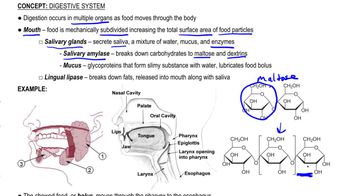
Understand the role of salivary amylase: Salivary amylase begins the digestion of starch in the mouth by breaking it down into smaller polysaccharides and maltose, but it does not complete the digestion into monosaccharides. Therefore, evaluate the statement about salivary amylase accordingly.
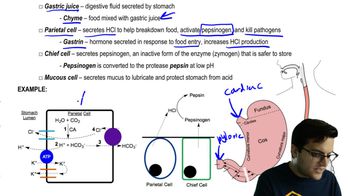
Examine the function of pepsin: Pepsin is an enzyme in the stomach that breaks down proteins into smaller peptides. It is active in the acidic environment of the stomach. Consider this information when evaluating the statement about pepsin.
Consider the role of trypsin: Trypsin is an enzyme produced by the pancreas and released into the small intestine, where it continues the digestion of proteins into smaller peptides. It does not digest disaccharides into monosaccharides. Use this knowledge to assess the statement about trypsin.
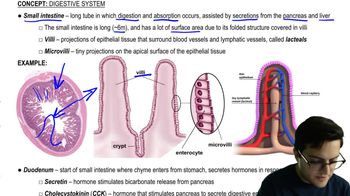
Analyze the function of pancreatic lipase: Pancreatic lipase is crucial for lipid digestion, breaking down triglycerides into fatty acids and glycerol in the small intestine. This enzyme performs the majority of chemical digestion of lipids. Reflect on this when evaluating the statement about pancreatic lipase.
For each statement, apply your understanding of the specific enzyme's function and location in the digestive process to determine whether the statement is true or false.

Verified video answer for a similar problem:

This video solution was recommended by our tutors as helpful for the problem above.
Video duration:
1m
Was this helpful?

Key Concepts

Here are the essential concepts you must grasp in order to answer the question correctly.

Salivary Amylase

Salivary amylase is an enzyme produced by the salivary glands that initiates the digestion of starches in the mouth. It breaks down starch into maltose and dextrins, but does not complete the digestion into monosaccharides, as further digestion occurs in the small intestine with other enzymes.
Recommended video:
Guided course
06:37
Mouth and Esophagus

Pepsin

Pepsin is a protease enzyme that is active in the acidic environment of the stomach. It is responsible for breaking down proteins into smaller peptides, initiating protein digestion. Pepsin is secreted as pepsinogen and activated by stomach acid, playing a crucial role in the digestive process.
Recommended video:

Pancreatic Lipase

Pancreatic lipase is an enzyme secreted by the pancreas into the small intestine, where it performs the majority of lipid digestion. It breaks down triglycerides into free fatty acids and monoglycerides, facilitating absorption. This enzyme is essential for the efficient digestion and absorption of dietary fats.
Recommended video:
Guided course
06:15
Small Intestine and Pancreas