Pearson+ LogoPearson+ Logo
Ch. 40 - Water and Electrolyte Balance in Animals
Freeman - Biological Science 8th Edition
Freeman8th EditionBiological ScienceISBN: 9780138276263Not the one you use?Change textbook
Chapter 40, Problem 2

Which of the following organisms would lose the most water by osmosis across its gills?
a. Marine bony fish
b. Shark
c. Freshwater fish
d. Freshwater invertebrate

Verified step by step guidance
1
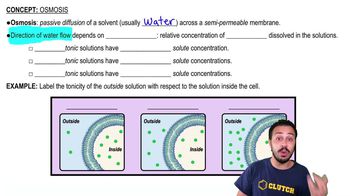
Understand the concept of osmosis: Osmosis is the movement of water across a semipermeable membrane from an area of lower solute concentration to an area of higher solute concentration.
Consider the environment of each organism: Marine organisms live in saltwater, which has a higher solute concentration than their body fluids, while freshwater organisms live in water with a lower solute concentration than their body fluids.
Analyze the marine bony fish: Marine bony fish are in a hypertonic environment, meaning the surrounding water has a higher solute concentration than their body fluids, leading to water loss by osmosis.
Analyze the shark: Sharks have a unique adaptation where they maintain a high concentration of urea in their body fluids, making them isotonic or slightly hypertonic to seawater, reducing water loss by osmosis.
Compare with freshwater organisms: Freshwater fish and invertebrates are in a hypotonic environment, meaning the surrounding water has a lower solute concentration than their body fluids, leading to water gain rather than loss by osmosis.

Verified video answer for a similar problem:

This video solution was recommended by our tutors as helpful for the problem above.
Video duration:
1m
Was this helpful?

Key Concepts

Here are the essential concepts you must grasp in order to answer the question correctly.

Osmosis

Osmosis is the movement of water across a semipermeable membrane from an area of lower solute concentration to an area of higher solute concentration. In aquatic organisms, osmosis affects how water is gained or lost through their gills, depending on the surrounding water's salinity.
Recommended video:

Marine vs Freshwater Environments

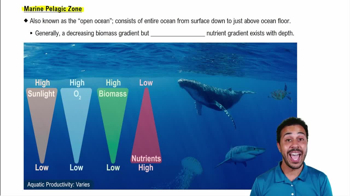
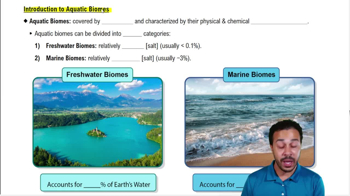
Marine environments have high salt concentrations, while freshwater environments have low salt concentrations. Organisms in these environments have adapted differently to regulate water and salt balance, influencing how they gain or lose water through osmosis.
Recommended video:
Guided course
02:14
Marine Pelagic Zone

Adaptations in Aquatic Organisms

Aquatic organisms have developed physiological adaptations to manage osmoregulation. Marine bony fish, for example, tend to lose water due to the high salinity of their environment, while freshwater organisms gain water due to the lower external solute concentration.
Recommended video:
Guided course
01:38
Introduction to Aquatic Biomes