


Pearson+ LogoPearson+ Logo
Ch. 40 - Water and Electrolyte Balance in Animals
Freeman - Biological Science 8th Edition
Freeman8th EditionBiological ScienceISBN: 9780138276263Not the one you use?Change textbook
Chapter 40, Problem 15e

Fish and other aquatic organisms are exposed to many types of water pollutants, including metals such as aluminum. Although a low level of aluminum is found in unpolluted water, many lakes and streams have an increased level because of mining, sewage treatment, and accidental spills of toxic materials. Aluminum pollution can result in mass fish die-offs.
True or false: Water moves by osmosis across a fish's gills to an area with a higher sodium ion concentration because water molecules are attracted to the sodium ions.

Verified step by step guidance
1
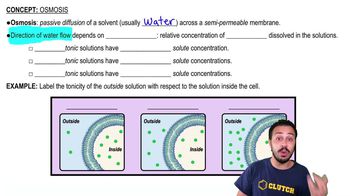
Understand the concept of osmosis: Osmosis is the movement of water across a semipermeable membrane from an area of lower solute concentration to an area of higher solute concentration.
Identify the role of sodium ions: Sodium ions are solutes that can affect the concentration gradient across the gills of fish.
Clarify the mechanism of osmosis: Water moves due to the concentration gradient, not because it is 'attracted' to sodium ions. The movement is driven by the difference in solute concentration.
Consider the environment of the fish's gills: The gills are semipermeable membranes where osmosis can occur, affecting the fish's ability to regulate its internal environment.
Evaluate the statement: Determine if the statement correctly describes the process of osmosis, focusing on the concept of concentration gradients rather than attraction to ions.

Verified video answer for a similar problem:

This video solution was recommended by our tutors as helpful for the problem above.
Video duration:
1m
Was this helpful?

Key Concepts

Here are the essential concepts you must grasp in order to answer the question correctly.

Osmosis

Osmosis is the movement of water molecules across a semipermeable membrane from an area of lower solute concentration to an area of higher solute concentration. This process is driven by the concentration gradient and does not require energy. In aquatic organisms, osmosis is crucial for maintaining fluid balance across cell membranes, including the gills of fish.
Recommended video:

Sodium Ion Concentration

Sodium ions (Na+) are a key component of the solute concentration in aquatic environments. The concentration of sodium ions can affect the osmotic balance in fish, as water tends to move towards areas with higher ion concentration. This movement is not due to attraction between water molecules and ions, but rather the tendency to equalize solute concentrations on both sides of a membrane.
Recommended video:
Guided course
04:51
Concentration Gradients and Diffusion

Impact of Aluminum Pollution

Aluminum pollution in water bodies can disrupt the normal physiological processes in fish, including osmoregulation. High levels of aluminum can damage gill tissues, impairing their ability to regulate ion and water balance. This can lead to stress and increased mortality in fish populations, as they struggle to maintain homeostasis in polluted environments.
Recommended video:
Guided course
03:35
Geographic Impact on Communities
Related Practice
Textbook Question

Fish and other aquatic organisms are exposed to many types of water pollutants, including metals such as aluminum. Although a low level of aluminum is found in unpolluted water, many lakes and streams have an increased level because of mining, sewage treatment, and accidental spills of toxic materials. Aluminum pollution can result in mass fish die-offs. In a laboratory, scientists exposed freshwater bony fish (Prochilodus lineatus) to water with a high level of aluminum and compared their blood osmolarity to that of fish exposed to water with a normal aluminum level (control). The results of the experiment are shown here (asterisks indicate P<0.05 between control and treated groups at a given time).

Do the data support the hypothesis that aluminum interferes with osmoregulation in freshwater fishes? Explain.

Textbook Question

Fish and other aquatic organisms are exposed to many types of water pollutants, including metals such as aluminum. Although a low level of aluminum is found in unpolluted water, many lakes and streams have an increased level because of mining, sewage treatment, and accidental spills of toxic materials. Aluminum pollution can result in mass fish die-offs.

Why did the scientists do this experiment in a laboratory instead of simply collecting fish from a river with a high aluminum level and documenting their osmoregulatory ability?

Textbook Question

Fish and other aquatic organisms are exposed to many types of water pollutants, including metals such as aluminum. Although a low level of aluminum is found in unpolluted water, many lakes and streams have an increased level because of mining, sewage treatment, and accidental spills of toxic materials. Aluminum pollution can result in mass fish die-offs. The scientists also measured the activity of Na+/K+-ATPase in the gills of the fish exposed to aluminum and compared it to that of the control fish.

What do you suppose were their results? Explain.

Textbook Question

Fish and other aquatic organisms are exposed to many types of water pollutants, including metals such as aluminum. Although a low level of aluminum is found in unpolluted water, many lakes and streams have an increased level because of mining, sewage treatment, and accidental spills of toxic materials. Aluminum pollution can result in mass fish die-offs.

Draw a graph similar to the one here showing how the results would be different if the experiment had been performed on marine bony fish in seawater. (Assume that the osmolarity of seawater is 1100 mOsm and the set point osmolarity of marine bony fishes is 290 mOsm.)