Pearson+ LogoPearson+ Logo
Ch. 38 - Flowering Plant Reproduction and Development
Freeman - Biological Science 8th Edition
Freeman8th EditionBiological ScienceISBN: 9780138276263Not the one you use?Change textbook
Chapter 38, Problem 6

What are the advantages and disadvantages of self-fertilization versus those of outcrossing?

Verified step by step guidance
1
Self-fertilization involves a single individual providing both gametes for reproduction, leading to a high degree of genetic similarity between parent and offspring. This can be advantageous in stable environments where the parent's traits are well-suited to survival, as it ensures those successful traits are passed on directly.
However, self-fertilization can also lead to inbreeding depression, where the accumulation of deleterious alleles causes reduced fitness in the population. This is a significant disadvantage as it can lead to a lack of genetic diversity, making the population more susceptible to diseases and environmental changes.
Outcrossing, or cross-fertilization, involves two individuals contributing gametes, which increases genetic diversity. This genetic variation is beneficial for adapting to changing environments and resisting evolving pathogens and diseases, thus potentially increasing the survival and reproduction success of offspring.
A disadvantage of outcrossing is that it requires finding and competing for mates, which can expend considerable time and energy. Additionally, successful traits present in an individual may not be passed as effectively if the mate carries different or less advantageous traits.
Outcrossing also exposes populations to outbreeding depression if individuals from different populations mate and produce offspring with incompatible or less fit genetic combinations. This can reduce the fitness of a population in certain ecological contexts.

Verified video answer for a similar problem:

This video solution was recommended by our tutors as helpful for the problem above.
Video duration:
2m
Was this helpful?

Key Concepts

Here are the essential concepts you must grasp in order to answer the question correctly.

Self-Fertilization

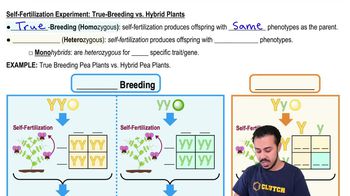
Self-fertilization is a reproductive strategy where an organism fertilizes its own gametes, leading to offspring that are genetically similar to the parent. This method can be advantageous in stable environments where the parent's traits are well-suited for survival. However, it reduces genetic diversity, which can make populations more vulnerable to diseases and environmental changes.
Recommended video:
Guided course
05:48
Self-Fertilization Experiment: True-Breeding vs. Hybrid Plants

Outcrossing

Outcrossing involves the fertilization of gametes from different individuals, promoting genetic diversity within a population. This increased variation can enhance adaptability and resilience to environmental changes and diseases. However, outcrossing may also require more energy and resources to find mates, and it can be less effective in isolated or sparse populations.
Recommended video:

Genetic Diversity

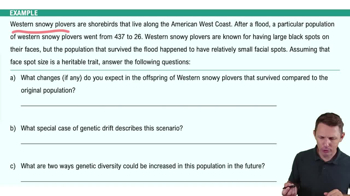
Genetic diversity refers to the total number of genetic characteristics in the genetic makeup of a species. High genetic diversity is crucial for the survival and adaptability of populations, as it allows for a wider range of traits that can be beneficial in changing environments. Conversely, low genetic diversity can lead to inbreeding depression, where the accumulation of deleterious alleles negatively impacts the health and viability of a population.
Recommended video:
02:37
Genetic Drift Example 2