Pearson+ LogoPearson+ Logo
Ch. 38 - Flowering Plant Reproduction and Development
Freeman - Biological Science 8th Edition
Freeman8th EditionBiological ScienceISBN: 9780138276263Not the one you use?Change textbook
Chapter 38, Problem 7

In what sense are the tissues produced in the shoot and root apical meristems of a 300-year-old oak tree 'embryonic'?

Verified step by step guidance
1
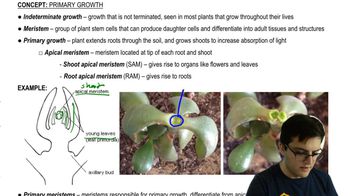
Identify the role of apical meristems: Apical meristems are regions of actively dividing cells located at the tips of roots and shoots in plants. They are responsible for primary growth, allowing the plant to extend in length.
Understand the concept of 'embryonic' tissues: In the context of plant biology, 'embryonic' refers to cells that have the potential to differentiate into various types of cells and tissues. These cells are undifferentiated and retain the ability to divide and give rise to new cells.
Relate embryonic nature to apical meristems: Even in a 300-year-old oak tree, the cells in the shoot and root apical meristems remain embryonic because they continue to be undifferentiated and capable of division, producing new tissues for growth.
Compare with animal embryonic cells: Similar to stem cells in animals, the embryonic cells in plant meristems can develop into various specialized cells needed by the organism, adapting to environmental changes and growth needs.
Conclude the significance: The 'embryonic' nature of the tissues in the apical meristems of an old oak tree highlights the plant's ongoing ability to grow and regenerate, crucial for its survival and adaptation over centuries.

Verified video answer for a similar problem:

This video solution was recommended by our tutors as helpful for the problem above.
Video duration:
40s
Was this helpful?

Key Concepts

Here are the essential concepts you must grasp in order to answer the question correctly.

Apical Meristems

Apical meristems are regions of actively dividing cells located at the tips of roots and shoots in plants. These tissues are responsible for primary growth, allowing the plant to elongate and develop new leaves and roots. The cells produced in these meristems are undifferentiated, meaning they have the potential to develop into various types of specialized tissues.
Recommended video:
Guided course
07:52
Primary Meristems

Embryonic Tissues

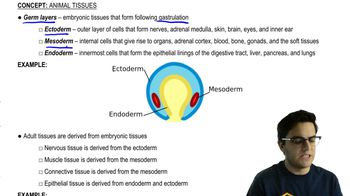
Embryonic tissues refer to undifferentiated cells that have the potential to develop into various cell types and tissues in an organism. In plants, the term 'embryonic' is used to describe cells that retain the ability to divide and differentiate, similar to the cells found in the early stages of development in embryos. This characteristic allows for continuous growth and adaptation throughout the plant's life.
Recommended video:
Guided course
01:47
Embryonic and Adult Tissues

Differentiation

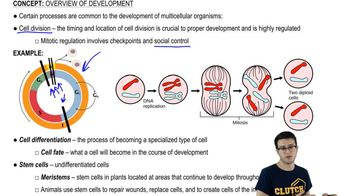
Differentiation is the process by which unspecialized cells develop into specialized cells with distinct functions and structures. In the context of apical meristems, differentiation occurs as the cells produced in these regions mature and take on specific roles, such as forming vascular tissues or leaves. The balance between cell division and differentiation is crucial for the growth and development of the plant.
Recommended video:
Guided course
05:28
Cell Division and Differentiation
Related Practice
Textbook Question

When does the apical–basal axis first become apparent?

a. When the epidermal, ground, and vascular tissues form

b. When the cotyledons, hypocotyl, and root form

c. When the first cell division produces the apical cell and basal cell

d. During the globular stage, when the suspensor is complete

Textbook Question

Why is the emergence of the radicle an important first step in germination?

a. Its hook helps protect the shoot that emerges later.

b. It carries out photosynthesis to supply the embryo with food.

c. It is important for establishing a supply of water to the growing embryo.

d. It is necessary to break the seed coat.

Textbook Question

What are the advantages and disadvantages of self-fertilization versus those of outcrossing?

Textbook Question

Human embryonic stem cells are capable of forming all types of cells in the human body. How are these cells similar to meristem cells in plants?

Textbook Question

Consider the following fruits: an acorn, a cherry, a burr, and a dandelion seed. Based on the structure of each of these fruits, predict how the seed is dispersed.

Design a study that would estimate the average distance that each type of seed is dispersed from the parent plant.

Textbook Question

Make a sketch of a simplified flower with all four organs, and indicate how the pattern of expression for just two genes (e.g., 'D' and 'E') could, hypothetically, regulate the development of each organ.

Consider that what's important is whether a gene is on or off and that a structure can be specified when neither gene is expressed.