Pearson+ LogoPearson+ Logo
Ch. 29 - Fungi
Freeman - Biological Science 8th Edition
Freeman8th EditionBiological ScienceISBN: 9780138276263Not the one you use?Change textbook
Chapter 29, Problem 13

Some fungi have elaborate mechanisms for dispersing spores. For example, the “squirt gun” fungus Pilobolus, which grows in cow dung, forcibly shoots off tiny black sporangia filled with spores. Any sporangia that are flung onto fresh grass are likely to be eaten by a grazing cow, passed through its digestive system unharmed, and deposited in a new batch of dung. The spores carried within the sporangia are perfectly positioned to grow into a new mycelium.
Would you describe the association between Pilobolus and cows as a symbiotic relationship? Explain your answer.

Verified step by step guidance
1
Begin by defining what a symbiotic relationship is. In biology, symbiosis refers to a close and long-term biological interaction between two different biological organisms. This can be mutualistic, commensalistic, or parasitic.
Identify the organisms involved in the association. In this case, the organisms are Pilobolus, a type of fungus, and cows.
Examine the nature of the interaction between Pilobolus and cows. Pilobolus grows on cow dung, which provides a nutrient-rich environment for the fungus to thrive. The fungus benefits from the cow dung as a substrate for growth.
Consider whether the cows benefit, are harmed, or are unaffected by the presence of Pilobolus. Typically, cows are not directly affected by the fungus growing on their dung, indicating a commensal relationship where Pilobolus benefits without affecting the cows.
Conclude whether the relationship fits the definition of symbiosis. Since Pilobolus benefits from the cow dung without affecting the cows, this can be described as a commensal symbiotic relationship.

Verified video answer for a similar problem:

This video solution was recommended by our tutors as helpful for the problem above.
Video duration:
1m
Was this helpful?

Key Concepts

Here are the essential concepts you must grasp in order to answer the question correctly.

Symbiotic Relationships

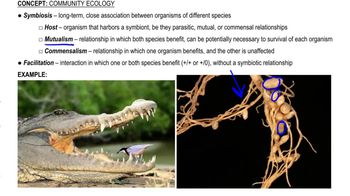
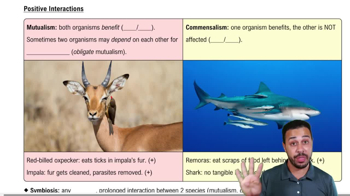
Symbiotic relationships are interactions between two different organisms living in close physical proximity, often to the benefit of one or both parties. These relationships can be mutualistic, commensalistic, or parasitic, depending on whether both, one, or neither organism benefits. Understanding these categories is crucial to determining the nature of the interaction between Pilobolus and cows.
Recommended video:

Pilobolus Fungus

Pilobolus is a genus of fungi known for its unique spore dispersal mechanism. It grows on herbivore dung, such as that of cows, and uses a specialized structure to launch its spores towards vegetation, which are then ingested by herbivores, completing its life cycle. This relationship with cows is essential for its reproduction and dispersal.
Recommended video:

Commensalism

Commensalism is a type of symbiotic relationship where one organism benefits while the other is neither helped nor harmed. In the context of Pilobolus and cows, Pilobolus benefits from the cow's dung as a growth medium, while the cow is largely unaffected by the presence of the fungus, illustrating a commensal relationship.
Recommended video:
Guided course
02:56
Positive Interactions
Related Practice
Textbook Question

Many mushrooms are extremely colorful. One hypothesis is that the colors serve as a warning to prevent animals from eating mushrooms, much like the bright yellow and black stripes on wasps help to deter potential predators. Design an experiment to test this hypothesis.

Textbook Question

Some fungi have elaborate mechanisms for dispersing spores. For example, the 'squirt gun' fungus Pilobolus, which grows in cow dung, forcibly shoots off tiny black sporangia filled with spores. Any sporangia that are flung onto fresh grass are likely to be eaten by a grazing cow, passed through its digestive system unharmed, and deposited in a new batch of dung. The spores carried within the sporangia are perfectly positioned to grow into a new mycelium.

Pilobolus is a zygomycete, and the sporangia just described produce asexual spores. In contrast, which of the following best describes what happens during the sexual phase of its life cycle?

a. It produces eight ascospores in each ascus.

b. It produces basidiospores that grow into mushrooms.

c. It produces motile sperm and eggs.

d. Hyphae from two compatible mating types fuse and form a zygosporangium.

Textbook Question

Some fungi have elaborate mechanisms for dispersing spores. For example, the “squirt gun” fungus Pilobolus, which grows in cow dung, forcibly shoots off tiny black sporangia filled with spores. Any sporangia that are flung onto fresh grass are likely to be eaten by a grazing cow, passed through its digestive system unharmed, and deposited in a new batch of dung. The spores carried within the sporangia are perfectly positioned to grow into a new mycelium.

Both asexual sporangia (shown in the photo) and zygosporangia can be found in cow dung. Make a simplified drawing that illustrates the events of plasmogamy, karyogamy, and meiosis that occur during sexual reproduction in Pilobolus. Be sure to indicate and label the zygosporangium.

Textbook Question

Explain the process of extracellular digestion that occurs during the growth of Pilobolus mycelia through dung.

Textbook Question

Using high-speed video, researchers have measured several variables associated with sporangium discharge in various spore-shooting fungi. Based on the data in the table shown here, how do the launch speed and acceleration of Pilobolus compare with those of the other fungi?

How does launch speed for each species compare with the top speed of 44 km/h reached by Jamaican athlete Usain Bolt during his 2009 world-record-setting 100-m race?

Textbook Question

Propose an experiment to test whether Pilobolus shoots its sporangia preferentially toward light. Hypothesize why such a preference might be advantageous.