Evaluate each of the following defects. Which could lead to uncontrolled growth in cancer? Select True or False for each statement. T/FThe overexpression of MPF activity. T/FA nonfunctional Rb protein. T/FThe overexpression of G1 cyclin. T/FA nonfunctional E2F protein.
Table 29.1 mentions that chytrids are responsible for massive die-offs currently occurring in amphibians. Review Koch's postulates; then design a study showing how you would use Koch's postulates to test the hypothesis that chytrid infections are responsible for frog deaths.

Verified step by step guidance
Verified video answer for a similar problem:
Key Concepts
Koch's Postulates
Chytrid Fungi
Amphibian Decline
Lignin and cellulose provide rigidity to the cell walls of plants. But in most fungi, chitin performs this role. Why is it logical that most fungi don't have lignin or cellulose in their cell walls?
Lawns are sometimes fertilized with nitrate that can be washed into neighboring woodlots by rain. If the trees in that woodlot are associated with EMF, what effect might the excess nitrate have on the fungi and/or trees?
a. Fungal growth may be stimulated, causing the trees to transport more nitrogen to the fungi.
b. The fungi may secrete more peptidases to break down the nitrate.
c. The trees may take up the nitrate directly into their roots and rely less on the fungi.
d. The excess nitrate may stimulate the fungi to transport more sugar to the trees.
Many mushrooms are extremely colorful. One hypothesis is that the colors serve as a warning to prevent animals from eating mushrooms, much like the bright yellow and black stripes on wasps help to deter potential predators. Design an experiment to test this hypothesis.
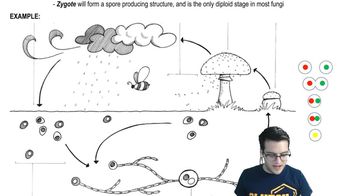
Some fungi have elaborate mechanisms for dispersing spores. For example, the 'squirt gun' fungus Pilobolus, which grows in cow dung, forcibly shoots off tiny black sporangia filled with spores. Any sporangia that are flung onto fresh grass are likely to be eaten by a grazing cow, passed through its digestive system unharmed, and deposited in a new batch of dung. The spores carried within the sporangia are perfectly positioned to grow into a new mycelium.
Pilobolus is a zygomycete, and the sporangia just described produce asexual spores. In contrast, which of the following best describes what happens during the sexual phase of its life cycle?
a. It produces eight ascospores in each ascus.
b. It produces basidiospores that grow into mushrooms.
c. It produces motile sperm and eggs.
d. Hyphae from two compatible mating types fuse and form a zygosporangium.
Some fungi have elaborate mechanisms for dispersing spores. For example, the “squirt gun” fungus Pilobolus, which grows in cow dung, forcibly shoots off tiny black sporangia filled with spores. Any sporangia that are flung onto fresh grass are likely to be eaten by a grazing cow, passed through its digestive system unharmed, and deposited in a new batch of dung. The spores carried within the sporangia are perfectly positioned to grow into a new mycelium.
Both asexual sporangia (shown in the photo) and zygosporangia can be found in cow dung. Make a simplified drawing that illustrates the events of plasmogamy, karyogamy, and meiosis that occur during sexual reproduction in Pilobolus. Be sure to indicate and label the zygosporangium.