
Pearson+ LogoPearson+ Logo
Ch. 25 - Phylogenies and the History of Life
Freeman - Biological Science 8th Edition
Freeman8th EditionBiological ScienceISBN: 9780138276263Not the one you use?Change textbook
Chapter 25, Problem 16

The vast majority of animals that ever existed are now extinct, but Tereza Jezkova and John Wiens wondered which variables were most important in driving the diversification of species that exist today. Why are there so many species in some phyla, such as Cnidaria (see photo), but so few in others, such as Ctenophora? The researchers know that correlation does not equal causation. However, can the absence of a correlation enable you to reject a hypothesis of causation? How would the R2 values be different in a scenario where a single trait was important to diversification in many phyla versus a scenario where different traits were important to diversification in different phyla?

Verified step by step guidance
1
Identify the key variables that might influence species diversification, such as environmental factors, genetic variability, and competition.
Understand the concept of correlation and causation in the context of biological research. Correlation between two variables does not imply that one causes the other, but it can suggest a relationship worth further investigation.
Discuss the significance of the absence of correlation. If there is no correlation between a proposed causative factor and the outcome (species diversification), it suggests that the factor might not be influential, allowing researchers to potentially reject that hypothesis.
Examine how R2 values (which measure the proportion of variance in the dependent variable that is predictable from the independent variable) would differ in diversification scenarios. A high R2 value in a scenario where a single trait influences diversification across many phyla suggests a strong, common causative factor. Conversely, low or varying R2 values across phyla where different traits influence diversification suggest multiple, phyla-specific factors.
Conclude by considering alternative hypotheses or additional variables that could explain the differences in species richness across different phyla, and design further studies to test these new hypotheses.

Verified video answer for a similar problem:

This video solution was recommended by our tutors as helpful for the problem above.
Video duration:
3m
Was this helpful?

Key Concepts

Here are the essential concepts you must grasp in order to answer the question correctly.

Species Diversification

Species diversification refers to the process by which new species arise and existing species evolve over time. This process is influenced by various factors, including environmental changes, ecological interactions, and evolutionary mechanisms such as natural selection and genetic drift. Understanding the patterns and drivers of diversification helps explain the varying numbers of species across different taxonomic groups.
Recommended video:
03:24
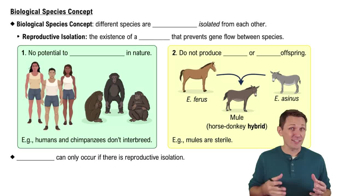
Biological Species Concept

Correlation vs. Causation

Correlation refers to a statistical relationship between two variables, while causation implies that one variable directly influences another. In biological research, establishing causation is crucial for understanding the mechanisms behind observed patterns. The absence of correlation can suggest that a hypothesized causal relationship may not exist, but it does not definitively prove causation is absent, as other factors may be at play.
Recommended video:
Guided course
03:39
Dominant vs. Recessive Alleles

R-squared (R2) Values

R-squared (R2) values are statistical measures that indicate the proportion of variance in a dependent variable that can be explained by one or more independent variables in a regression model. A high R2 value suggests a strong relationship between the variables, while a low R2 indicates a weak relationship. In the context of species diversification, different R2 values in scenarios with single versus multiple traits can reveal how well those traits account for the observed diversity across phyla.
Recommended video:
Guided course
04:08
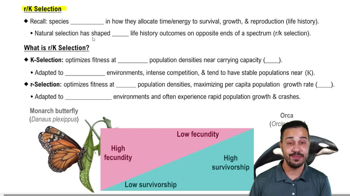
r/K Selection
Related Practice
Textbook Question

The vast majority of animals that ever existed are now extinct, but Tereza Jezkova and John Wiens wondered which variables were most important in driving the diversification of species that exist today. Why are there so many species in some phyla, such as Cnidaria (see photo), but so few in others, such as Ctenophora? Jezkova and Wiens used a type of graph called a linear regression to find correlations between variables such as the proportion of species per phylum with legs (on the y-axis) and the diversification rate per phylum (on the x-axis). Sketch a graph to show what a strong positive correlation between these two variables would look like and what the absence of a correlation would look like.

Textbook Question

The vast majority of animals that ever existed are now extinct, but Tereza Jezkova and John Wiens wondered which variables were most important in driving the diversification of species that exist today. Why are there so many species in some phyla, such as Cnidaria (see photo), but so few in others, such as Ctenophora? A sample of Jekova and Wiens' results is shown here. The R2 value represents the strength of the correlation (where 0.00 is lowest and 1.00 is highest). The P value represents the statistical significance. Which five traits look most important?

Textbook Question

Which traits do not correlate strongly with diversification rate within phyla but are likely to have been important in the original diversification of animal phyla during the Cambrian? Select True or False for each trait.

T/F presence of a head

T/F mobile lifestyle

T/F terrestrial lifestyle

T/F bilateral symmetry

2
views