Pearson+ LogoPearson+ Logo
Ch. 25 - Phylogenies and the History of Life
Freeman - Biological Science 8th Edition
Freeman8th EditionBiological ScienceISBN: 9780138276263Not the one you use?Change textbook
Chapter 25, Problem 1

Choose the best definition of a fossil.
a. A rock that contains information about an organism
b. A bone, tooth, shell, or other hard part of an organism that has been preserved
c. Any trace of an organism that lived in the past
d. Any part of a dead organism

Verified step by step guidance
1
Understand the concept of a fossil: Fossils are the preserved remains or traces of organisms that lived in the past. They provide valuable information about the history of life on Earth.
Consider the types of fossils: Fossils can be actual remains like bones, teeth, or shells, or they can be traces such as footprints, burrows, or imprints.
Evaluate the options: Option a suggests a rock containing information, which is not specific to fossils. Option b focuses on hard parts, which are common but not exclusive to fossils. Option c encompasses any trace, which is a broader and more inclusive definition. Option d refers to any part of a dead organism, which is too general.
Identify the most comprehensive definition: A fossil is not limited to hard parts or any part of a dead organism; it includes traces and remains that provide evidence of past life.
Select the best definition: Based on the understanding that fossils include both remains and traces, option c, 'any trace of an organism that lived in the past,' is the most accurate and comprehensive definition.

Verified video answer for a similar problem:

This video solution was recommended by our tutors as helpful for the problem above.
Video duration:
34s
Was this helpful?

Key Concepts

Here are the essential concepts you must grasp in order to answer the question correctly.

Fossil Definition

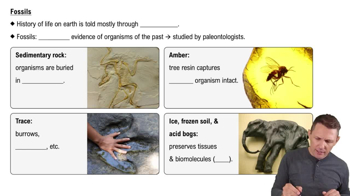
A fossil is any preserved evidence of an organism that lived in the past. This can include not only the hard parts like bones and shells but also traces such as footprints, burrows, or even chemical markers. The key aspect is that fossils provide information about past life forms and their environments.
Recommended video:
03:54
Fossils

Preservation of Organisms

Preservation refers to the process by which remains or traces of organisms are protected from decay and remain intact over geological time. This can occur through various means, such as mineralization, where organic material is replaced by minerals, or through natural encasement in substances like amber or ice.
Recommended video:
Guided course
06:52
Organization of DNA in the Cell

Trace Fossils

Trace fossils, also known as ichnofossils, are geological records of biological activity. They include footprints, burrows, and other indirect signs of an organism's presence, rather than the organism itself. These traces provide valuable insights into the behavior and movement of ancient life forms.
Recommended video:
03:54
Fossils