
Pearson+ LogoPearson+ Logo
Ch. 2 - Water and Carbon: The Chemical Basis of Life
Freeman - Biological Science 8th Edition
Freeman8th EditionBiological ScienceISBN: 9780138276263Not the one you use?Change textbook
Chapter 2, Problem 3

Which of these functional groups is known to be used for storing large amounts of chemical energy?
a. Amino group
b. Carbonyl group
c. Phosphate group
d. Sulfhydryl group

Verified step by step guidance
1
Identify the functional groups listed in the problem: amino group, carbonyl group, phosphate group, and sulfhydryl group.
Understand the role of each functional group in biological molecules: Amino groups are found in amino acids, carbonyl groups are found in ketones and aldehydes, phosphate groups are found in ATP and nucleotides, and sulfhydryl groups are found in thiols.
Recall that the phosphate group is a key component of ATP (adenosine triphosphate), which is the primary energy carrier in cells.
Recognize that the high-energy bonds between phosphate groups in ATP store and release energy during cellular processes.
Conclude that the phosphate group is known for storing large amounts of chemical energy, making it the correct answer.

Verified video answer for a similar problem:

This video solution was recommended by our tutors as helpful for the problem above.
Video duration:
1m
Was this helpful?

Key Concepts

Here are the essential concepts you must grasp in order to answer the question correctly.

Functional Groups

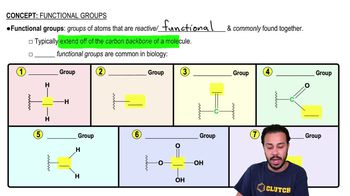
Functional groups are specific groups of atoms within molecules that have characteristic properties and reactivity. They play a crucial role in the chemical behavior of organic compounds, influencing molecular interactions and reactions. Understanding functional groups is essential for predicting the properties and functions of molecules in biological systems.
Recommended video:
Guided course
06:04
Functional Groups

Phosphate Group

The phosphate group consists of a phosphorus atom bonded to four oxygen atoms and is known for its role in storing and transferring energy in biological systems. It is a key component of ATP (adenosine triphosphate), the primary energy carrier in cells, where the high-energy bonds between phosphate groups are used to fuel cellular processes.
Recommended video:
Guided course
06:04
Functional Groups

Chemical Energy Storage

Chemical energy storage involves the accumulation of energy in chemical bonds, which can be released during chemical reactions. In biological systems, molecules like ATP store energy in their phosphate bonds, which can be harnessed for various cellular activities. Understanding how energy is stored and released is fundamental to studying metabolism and energy transfer in cells.
Recommended video:
Guided course
04:58
Introduction to Energy