Pearson+ LogoPearson+ Logo
Ch. 19 - Control of Gene Expression in Eukaryotes
Freeman - Biological Science 8th Edition
Freeman8th EditionBiological ScienceISBN: 9780138276263Not the one you use?Change textbook
Chapter 19, Problem 6

Imagine discovering a loss-of-function mutation in a eukaryotic gene. You determine the gene's nucleotide sequence from the start site for transcription to the termination point of transcription and find no differences from the wild-type sequence. Explain where you think the mutation might be and how the mutation might be acting.

Verified step by step guidance
1
Consider the possibility that the mutation is located in a regulatory region rather than within the coding sequence itself. Regulatory regions include promoters, enhancers, and silencers, which control the expression of the gene.
Examine the promoter region, which is upstream of the transcription start site. A mutation here could affect the binding of transcription factors or RNA polymerase, leading to reduced or abolished transcription.
Investigate the enhancer regions, which can be located far from the gene they regulate. A mutation in an enhancer could disrupt the binding of activator proteins, reducing the gene's expression levels.
Consider the possibility of a mutation in the splice sites or intronic regions. Such mutations could lead to improper splicing of the pre-mRNA, resulting in a non-functional protein product.
Explore the potential for epigenetic changes, such as DNA methylation or histone modification, which could silence the gene without altering the nucleotide sequence. These changes can affect chromatin structure and gene accessibility.

Verified video answer for a similar problem:

This video solution was recommended by our tutors as helpful for the problem above.
Video duration:
3m
Was this helpful?

Key Concepts

Here are the essential concepts you must grasp in order to answer the question correctly.

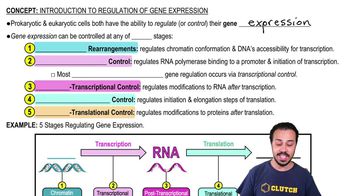
Gene Expression Regulation

Gene expression regulation involves controlling the timing, location, and amount of a gene's product being produced. In eukaryotes, this regulation can occur at multiple levels, including transcription, RNA processing, and translation. Mutations affecting regulatory elements, such as promoters or enhancers, can lead to loss-of-function by altering the gene's expression without changing the coding sequence.
Recommended video:
Guided course
06:40
Introduction to Regulation of Gene Expression

Non-coding Regions

Non-coding regions of DNA, such as introns, promoters, and enhancers, play crucial roles in gene regulation. Mutations in these areas can affect gene function by disrupting the normal regulatory processes, even if the coding sequence remains unchanged. These mutations can impact transcription factor binding, RNA splicing, or other regulatory mechanisms, leading to altered gene expression.
Recommended video:

Post-transcriptional Modifications

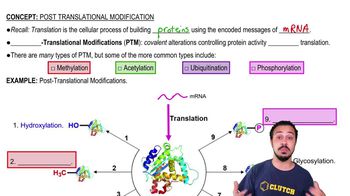
Post-transcriptional modifications include processes like RNA splicing, editing, and transport, which are essential for producing functional mRNA. Mutations affecting these processes can result in loss-of-function by producing defective mRNA or preventing its proper translation. Such mutations might not alter the nucleotide sequence but can disrupt the normal maturation and function of the mRNA.
Recommended video:
Guided course
04:26
Post-Translational Modification
Related Practice
Textbook Question

Compare and contrast the items in each pair:

(a) enhancers and the E. coli CAP binding site

1
views
Textbook Question

Compare and contrast the items in each pair:

(b) promoter-proximal elements and the operator of the lac operon

Textbook Question

Compare and contrast the items in each pair:

(c) general transcription factors and sigma.

Textbook Question

The following statements are about the control of chromatin condensation. Select True or False for each.

T/F Reducing histone acetylase activity is likely to decrease gene transcription.

T/F Mutations that reduce the number of positively charged amino acids on histones should promote open chromatin.

T/F Chromatin remodeling complexes add chemical groups to histones.

T/F Adding an inhibitor of DNA methylation is likely to reduce gene transcription.

Textbook Question

Predict how a mutation that caused continuous production of active p53 would affect the cell.

Textbook Question

In the follow-up work to the experiment shown in Figure 19.6, the researchers used a technique that allowed them to see if two DNA sequences are in close physical proximity (association). They applied this method to examine how often an enhancer and the core promoter of the Hnf4a regulatory gene were near each other. A logical prediction is that compared with rats born to mothers fed a healthy diet, the Hnf4a gene in rats born to mothers fed a protein-poor diet would


a. Show no difference in how often the promoter and enhancer associated

b. Never show any promoter–enhancer association

c. Show a lower frequency of promoter–enhancer association

d. Show a higher frequency of promoter–enhancer association