Pearson+ LogoPearson+ Logo
Ch. 19 - Control of Gene Expression in Eukaryotes
Freeman - Biological Science 8th Edition
Freeman8th EditionBiological ScienceISBN: 9780138276263Not the one you use?Change textbook
Chapter 19, Problem 5c

Compare and contrast the items in each pair:
(c) general transcription factors and sigma.

Verified step by step guidance
1
Understand the role of transcription factors and sigma factors in the process of transcription. Transcription is the process by which DNA is copied into RNA, and both general transcription factors and sigma factors play crucial roles in initiating this process.
General transcription factors are proteins that assist in the initiation of transcription in eukaryotic cells. They help in the assembly of the transcription machinery at the promoter region of genes, facilitating the binding of RNA polymerase II to the DNA template.
Sigma factors are proteins found in prokaryotic cells, specifically bacteria, that are essential for the initiation of transcription. They bind to RNA polymerase and direct it to specific promoter regions on the DNA, ensuring that transcription begins at the correct site.
Compare the specificity: General transcription factors are involved in the transcription of most genes in eukaryotic cells, providing a general mechanism for transcription initiation. Sigma factors, on the other hand, can be specific to certain sets of genes, allowing bacteria to respond to environmental changes by altering gene expression.
Contrast the complexity: The assembly of general transcription factors in eukaryotes is typically more complex, involving multiple proteins and regulatory sequences. Sigma factors in prokaryotes provide a simpler mechanism for transcription initiation, often involving fewer components and a more direct interaction with RNA polymerase.

Verified video answer for a similar problem:

This video solution was recommended by our tutors as helpful for the problem above.
Video duration:
34s
Was this helpful?

Key Concepts

Here are the essential concepts you must grasp in order to answer the question correctly.

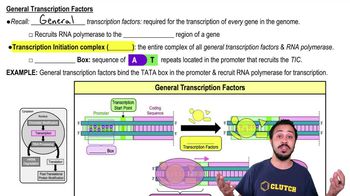
General Transcription Factors

General transcription factors are proteins essential for the initiation of transcription in eukaryotic cells. They assist in the assembly of the transcription machinery at the promoter region of genes, facilitating the binding of RNA polymerase II. These factors are necessary for the transcription of all protein-coding genes and help in the formation of the transcription initiation complex.
Recommended video:
Guided course
03:51
General Transcription Factors

Sigma Factor

Sigma factors are proteins in prokaryotic cells that play a crucial role in the initiation of transcription. They are a component of the RNA polymerase holoenzyme and are responsible for recognizing and binding to specific promoter sequences on the DNA. Sigma factors ensure that RNA polymerase initiates transcription at the correct site, and different sigma factors can direct the polymerase to different sets of genes.
Recommended video:
Guided course
01:39
Density-Independent Factors

Comparison of General Transcription Factors and Sigma Factors

While both general transcription factors and sigma factors are involved in the initiation of transcription, they operate in different domains: eukaryotic and prokaryotic cells, respectively. General transcription factors are part of a complex, multi-step process involving multiple proteins, whereas sigma factors are simpler, directly associating with RNA polymerase to guide it to the promoter. Both are essential for accurate transcription initiation, but their mechanisms and complexity differ significantly.
Recommended video:
Guided course
03:51
General Transcription Factors
Related Practice
Textbook Question

What is alternative splicing?

a. Phosphorylation that leads to different types of post-translational regulation

b. mRNA processing that leads to different combinations of exons being spliced together

c. Folding that leads to proteins with alternative conformations

d. The outcome of regulatory proteins that leads to changes in the life span of an mRNA

Textbook Question

Compare and contrast the items in each pair:

(a) enhancers and the E. coli CAP binding site

1
views
Textbook Question

Compare and contrast the items in each pair:

(b) promoter-proximal elements and the operator of the lac operon

Textbook Question

Imagine discovering a loss-of-function mutation in a eukaryotic gene. You determine the gene's nucleotide sequence from the start site for transcription to the termination point of transcription and find no differences from the wild-type sequence. Explain where you think the mutation might be and how the mutation might be acting.

Textbook Question

The following statements are about the control of chromatin condensation. Select True or False for each.

T/F Reducing histone acetylase activity is likely to decrease gene transcription.

T/F Mutations that reduce the number of positively charged amino acids on histones should promote open chromatin.

T/F Chromatin remodeling complexes add chemical groups to histones.

T/F Adding an inhibitor of DNA methylation is likely to reduce gene transcription.

Textbook Question

Predict how a mutation that caused continuous production of active p53 would affect the cell.