Pearson+ LogoPearson+ Logo
Ch. 14 - Mendel and the Gene
Freeman - Biological Science 8th Edition
Freeman8th EditionBiological ScienceISBN: 9780138276263Not the one you use?Change textbook
Chapter 14, Problem 3

The alleles found in haploid organisms cannot be dominant or recessive. Why?
a. Dominance and recessiveness describe which of two possible phenotypes are exhibited when two different alleles occur in the same individual.
b. Because only one allele is present, alleles in haploid organisms are always dominant.
c. Alleles in haploid individuals are transmitted like mitochondrial DNA or chloroplast DNA.
d. Most haploid individuals are bacteria, and bacterial genetics is completely different from eukaryotic genetics.

Verified step by step guidance
1
Understand the concept of dominance and recessiveness: These terms are used to describe the relationship between two alleles in a diploid organism, where one allele can mask the expression of another.
Recognize that haploid organisms have only one set of chromosomes, meaning they have only one allele for each gene.
Since there is only one allele present in haploid organisms, there is no second allele to compare it to, making the concepts of dominance and recessiveness irrelevant.
Consider the definition of dominance and recessiveness: These terms are used when two different alleles are present in the same individual, which is not the case in haploid organisms.
Conclude that option (a) is correct because dominance and recessiveness require two alleles to compare, which is not applicable in haploid organisms with only one allele per gene.

Verified video answer for a similar problem:

This video solution was recommended by our tutors as helpful for the problem above.
Video duration:
32s
Was this helpful?

Key Concepts

Here are the essential concepts you must grasp in order to answer the question correctly.

Haploid Organisms

Haploid organisms have a single set of chromosomes, meaning they possess only one allele for each gene. This contrasts with diploid organisms, which have two sets of chromosomes and thus two alleles for each gene. In haploids, the concept of dominance and recessiveness does not apply because there is no allele pair to compare; the single allele present directly determines the phenotype.
Recommended video:
Guided course
06:52
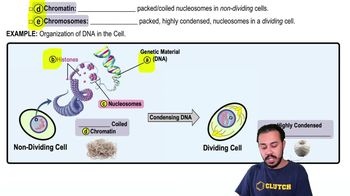
Organization of DNA in the Cell

Dominance and Recessiveness

Dominance and recessiveness are terms used to describe the relationship between alleles in diploid organisms. When two different alleles are present, the dominant allele's trait is expressed in the phenotype, while the recessive allele's trait is masked. This concept is irrelevant in haploid organisms, as they have only one allele per gene, eliminating the possibility of allele interaction.
Recommended video:
Guided course
03:39
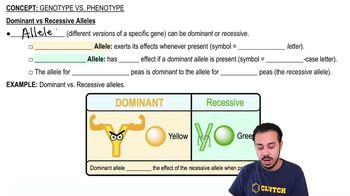
Dominant vs. Recessive Alleles

Genetic Transmission in Haploids

In haploid organisms, genetic transmission occurs through a single allele per gene, similar to the inheritance patterns seen in organelle DNA like mitochondrial or chloroplast DNA. This means that the genetic information is passed on without the complexity of allele interactions seen in diploid organisms, simplifying the inheritance pattern to a direct transmission of the single allele present.
Recommended video:
Guided course
04:14
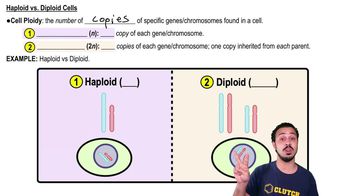
Haploid vs. Diploid Cells
Related Practice
Textbook Question

The genes for the traits that Mendel worked with are either all located on different chromosomes or behave as if they were. How did this help Mendel recognize the principle of independent assortment?

a. Otherwise, his dihybrid crosses would not have produced a 9 : 3 : 3 : 1 ratio of F2 phenotypes.

b. The occurrence of individuals with unexpected phenotypes led him to the discovery of recombination.

c. It led him to the realization that the behavior of chromosomes during meiosis explained his results.

d. It meant that the alleles involved were either dominant or recessive, which gave 3 : 1 ratios in the F1 generation.

2
views
Textbook Question

Why is the pea wrinkle-seed allele a recessive allele?

a. It 'recedes' in the F2 generation when homozygous parents are crossed.

b. The trait associated with the allele is not exhibited in heterozygotes.

c. Individuals with the allele have lower fitness than that of individuals with the dominant allele.

d. The allele is less common than the dominant allele. (The wrinkled allele is a rare mutant.)

Textbook Question

Two black female mice are crossed with a brown male. In several litters, female I produced 9 black offspring and 7 brown; female II produced 57 black offspring. What deductions can you make about the inheritance of black and brown coat color in mice? What are the genotypes of the parents?

1
views
Textbook Question

A plant with orange, spotted flowers was grown in the greenhouse from a seed collected in the wild. The plant was self-pollinated and gave rise to the following progeny: 88 orange with spots, 34 yellow with spots, 32 orange with no spots, and 8 yellow with no spots. What can you conclude about the dominance relationships of the alleles responsible for the spotted and unspotted phenotypes? What can you conclude about the genotype of the original plant that had orange, spotted flowers?

Textbook Question

In peas, purple flowers are dominant to white. If a purple-flowered, heterozygous plant were crossed with a white-flowered plant, what is the expected ratio of genotypes and phenotypes among the F1 offspring? If two of the purple-flowered F1 offspring were randomly selected and crossed, what is the expected ratio of genotypes and phenotypes among the F2 offspring?