Textbook Question
Which structure or compartment is part of the symplast?
a. The interior of a vessel element
b. The interior of a sieve tube
c. The cell wall of a mesophyll cell
d. An extracellular air space

 Urry 11th EditionCh. 36 - Resource Acquisition and Transport in Vascular PlantsProblem 5
 Verified step by step guidance
 11:32
11:32
 05:59
05:59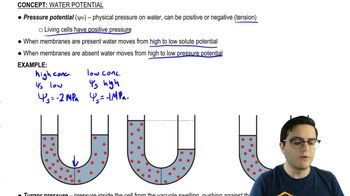 11:58
11:58Which structure or compartment is part of the symplast?
a. The interior of a vessel element
b. The interior of a sieve tube
c. The cell wall of a mesophyll cell
d. An extracellular air space
Movement of phloem sap from a source to a sink
a. Occurs through the apoplast of sieve-tube elements
b. Depends ultimately on the activity of proton pumps
c. Depends on tension, or negative pressure potential
d. Results mainly from diffusion
Photosynthesis ceases when leaves wilt, mainly because
a. The chlorophyll in wilting leaves is degraded.
b. Accumulation of CO2 in the leaf inhibits enzymes.
c. Stomata close, preventing CO2 from entering the leaf.
d. Photolysis, the water-splitting step of photosynthesis, cannot occur when there is a water deficiency.
A plant cell with a ΨS of −0.65MPa maintains a constant volume when bathed in a solution that has a ΨS of −0.30MPa and is in an open container. The cell has a
a. ΨP of +0.65MPa
b. Ψ of −0.65MPa
c. ΨP of +0.35MPa
d. ΨP of 0 MPa
Compared with a cell with few aquaporin proteins in its membrane, a cell containing many aquaporin proteins will
a. Have a faster rate of osmosis
b. Have a lower water potential
c. Have a higher water potential
d. Accumulate water by active transport
Which of the following would tend to increase transpiration?
a. Spiny leaves
b. Sunken stomata
c. A thicker cuticle
d. Higher stomatal density