
Pearson+ LogoPearson+ Logo
Ch. 36 - Resource Acquisition and Transport in Vascular Plants
Campbell - Campbell Biology 11th Edition
Urry11th EditionCampbell BiologyISBN: 9789357423311Not the one you use?Change textbook
Chapter 36, Problem 3

Movement of phloem sap from a source to a sink
a. Occurs through the apoplast of sieve-tube elements
b. Depends ultimately on the activity of proton pumps
c. Depends on tension, or negative pressure potential
d. Results mainly from diffusion

Verified step by step guidance
1
Understand the concept of phloem sap movement: Phloem sap is transported from a source (where it is produced, like leaves) to a sink (where it is used or stored, like roots or fruits). This process is known as translocation.
Identify the mechanism of phloem transport: Phloem transport is primarily driven by pressure flow, also known as the mass flow hypothesis. This involves the active transport of sugars into the phloem, creating a high osmotic pressure that drives the flow of sap.
Consider the role of proton pumps: Proton pumps are involved in creating a proton gradient across the cell membrane, which is crucial for the active transport of sucrose into the phloem. This active transport is essential for generating the pressure gradient needed for sap movement.
Evaluate the options given: Analyze each option to determine which one correctly describes the mechanism of phloem sap movement. Consider the role of proton pumps and pressure potential in the process.
Conclude with the correct understanding: Based on the pressure flow mechanism, the movement of phloem sap depends on the activity of proton pumps to create the necessary pressure gradient for sap flow from source to sink.

Verified video answer for a similar problem:

This video solution was recommended by our tutors as helpful for the problem above.
Video duration:
1m
Was this helpful?

Key Concepts

Here are the essential concepts you must grasp in order to answer the question correctly.

Phloem Transport

Phloem transport involves the movement of organic nutrients, primarily sugars, from a source (where they are produced, like leaves) to a sink (where they are used or stored, like roots or fruits). This process is essential for distributing energy throughout the plant and is driven by pressure differences between source and sink.
Recommended video:
Guided course
02:37
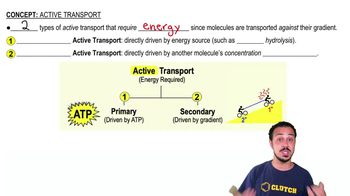
Active Transport

Proton Pumps

Proton pumps are integral membrane proteins that actively transport protons (H+) across cell membranes, creating a proton gradient. This gradient is crucial for various cellular processes, including the active transport of nutrients in plants, as it provides the energy needed for the movement of substances against their concentration gradient.
Recommended video:
Guided course
08:38
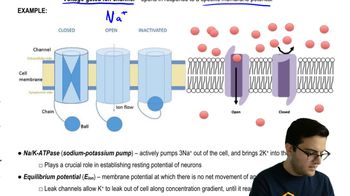
Ion Channels and Pumps

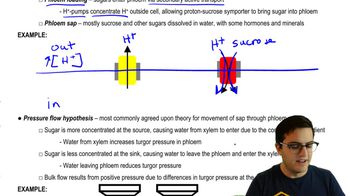
Pressure Flow Hypothesis

The pressure flow hypothesis explains the mechanism of phloem transport, suggesting that the movement of sap is driven by a pressure gradient created by osmotic pressure. Sugars are actively loaded into the phloem at the source, increasing osmotic pressure and drawing water in, which generates a flow towards the sink where sugars are unloaded.
Recommended video:
Guided course
07:10
Pressure Flow Hypothesis