
Pearson+ LogoPearson+ Logo
Ch. 18 - Regulation of Gene Expression
Campbell - Campbell Biology 11th Edition
Urry11th EditionCampbell BiologyISBN: 9789357423311Not the one you use?Change textbook
Chapter 18, Problem 3

The functioning of enhancers is an example of
a. A eukaryotic equivalent of prokaryotic promoter functioning.
b. Transcriptional control of gene expression.
c. The stimulation of translation by initiation factors.
d. Post-translational control that activates certain proteins.

Verified step by step guidance
1
Understand the role of enhancers in gene expression. Enhancers are DNA sequences that increase the transcription of associated genes.
Recognize that enhancers are involved in transcriptional control, which is the process of regulating the transcription of genes into mRNA.
Differentiate between transcriptional control and other levels of gene expression regulation, such as translational control and post-translational control.
Identify that enhancers do not directly stimulate translation or activate proteins post-translationally, but rather influence the transcription process.
Conclude that the functioning of enhancers is an example of transcriptional control of gene expression, aligning with option b.

Verified video answer for a similar problem:

This video solution was recommended by our tutors as helpful for the problem above.
Video duration:
43s
Was this helpful?

Key Concepts

Here are the essential concepts you must grasp in order to answer the question correctly.

Enhancers

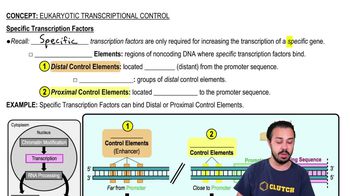
Enhancers are DNA sequences that can significantly increase the transcription of genes. They function by binding transcription factors, which help recruit the transcription machinery to the promoter region of a gene, thus enhancing gene expression. Unlike promoters, enhancers can be located far from the gene they regulate and can work in either orientation.
Recommended video:
Guided course
03:57
Specific Transcription Factors

Transcriptional Control

Transcriptional control refers to the regulation of gene expression at the level of transcription, where the synthesis of RNA from DNA is modulated. This control is crucial for determining which genes are expressed in a cell, influencing cell function and identity. Enhancers play a key role in transcriptional control by facilitating the binding of transcription factors to the promoter region.
Recommended video:
Guided course
03:57
Specific Transcription Factors

Gene Expression

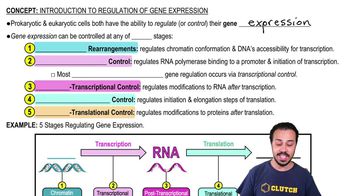
Gene expression is the process by which information from a gene is used to synthesize functional gene products, typically proteins. This process involves transcription and translation, and is regulated at multiple levels, including transcriptional, post-transcriptional, translational, and post-translational stages. Enhancers are involved in the transcriptional regulation of gene expression, affecting how much and when a gene is expressed.
Recommended video:
Guided course
06:40
Introduction to Regulation of Gene Expression