
Pearson+ LogoPearson+ Logo
Ch. 18 - Regulation of Gene Expression
Campbell - Campbell Biology 11th Edition
Urry11th EditionCampbell BiologyISBN: 9789357423311Not the one you use?Change textbook
Chapter 18, Problem 6

What would occur if the repressor of an inducible operon were mutated so it could not bind the operator?
a. Irreversible binding of the repressor to the promoter
b. Reduced transcription of the operon's genes
c. Buildup of a substrate for the pathway controlled by the operon
d. Continuous transcription of the operon's genes

Verified step by step guidance
1
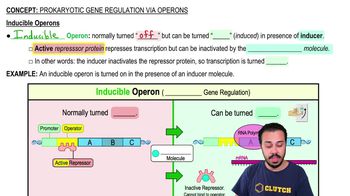
Understand the role of a repressor in an inducible operon: In an inducible operon, the repressor protein binds to the operator region to prevent transcription. When an inducer molecule is present, it binds to the repressor, causing it to change shape and release from the operator, allowing transcription to proceed.
Consider the effect of a mutation that prevents the repressor from binding to the operator: If the repressor cannot bind to the operator, it cannot block RNA polymerase from transcribing the genes in the operon.
Analyze the consequences of continuous transcription: Without the repressor binding to the operator, RNA polymerase can continuously transcribe the operon's genes, leading to the production of mRNA and, subsequently, the proteins encoded by the operon.
Evaluate the options given in the problem: Option a (irreversible binding of the repressor to the promoter) is incorrect because the mutation prevents binding. Option b (reduced transcription) is incorrect because transcription would increase. Option c (buildup of a substrate) is not directly related to the mutation's effect on transcription. Option d (continuous transcription) aligns with the expected outcome of the mutation.
Conclude that the correct answer is option d: The mutation results in continuous transcription of the operon's genes, as the repressor cannot bind to the operator to inhibit transcription.

Verified video answer for a similar problem:

This video solution was recommended by our tutors as helpful for the problem above.
Video duration:
2m
Was this helpful?

Key Concepts

Here are the essential concepts you must grasp in order to answer the question correctly.

Inducible Operon

An inducible operon is a segment of DNA that includes genes regulated by a repressor protein. In its default state, the repressor binds to the operator, preventing transcription. When an inducer molecule is present, it binds to the repressor, causing it to release from the operator, allowing transcription to proceed. This system is typically used to regulate genes involved in catabolic pathways.
Recommended video:
Guided course
04:25
Inducible Operons

Repressor Protein

A repressor protein is a regulatory protein that binds to the operator region of an operon, inhibiting the transcription of downstream genes. In inducible operons, the repressor is inactivated by an inducer, allowing gene expression. If a mutation prevents the repressor from binding to the operator, the genes may be transcribed continuously, as the repressor cannot block RNA polymerase.
Recommended video:

Operator Region

The operator is a segment of DNA within an operon where the repressor protein binds to regulate gene expression. It acts as a switch that can turn gene transcription on or off. In inducible operons, the presence of an inducer prevents the repressor from binding to the operator, thus allowing transcription. A mutation that prevents repressor binding would result in continuous gene transcription.
Recommended video:
Guided course
05:07
Terrestrial Biomes: Northern Regions Example 1
Related Practice
Textbook Question

The functioning of enhancers is an example of

a. A eukaryotic equivalent of prokaryotic promoter functioning.

b. Transcriptional control of gene expression.

c. The stimulation of translation by initiation factors.

d. Post-translational control that activates certain proteins.

Textbook Question

Cell differentiation always involves

a. Transcription of the myoD gene.

b. The movement of cells.

c. The production of tissue-specific proteins.

d. The selective loss of certain genes from the genome.

Textbook Question

Which of the following is an example of post-transcriptional control of gene expression?

a. The addition of methyl groups to cytosine bases of DNA

b. The binding of transcription factors to a promoter

c. The removal of introns and alternative splicing of exons

d. Gene amplification contributing to cancer

Textbook Question

Absence of bicoid mRNA from a Drosophila egg leads to the absence of anterior larval body parts and mirror-image duplication of posterior parts. This is evidence that the product of the bicoid gene

a. Normally leads to formation of head structures.

b. Normally leads to formation of tail structures.

c. Is transcribed in the early embryo.

d. Is a protein present in all head structures.

Textbook Question

Which of the following statements about the DNA in one of your brain cells is true?

a. Most of the DNA codes for protein.

b. The majority of genes are likely to be transcribed.

c. It is the same as the DNA in one of your liver cells.

d. Each gene lies immediately adjacent to an enhancer.

Textbook Question

Within a cell, the amount of protein made using a given mRNA molecule depends partly on

a. The degree of DNA methylation

b. The rate at which the mRNA is degraded

c. The number of introns present in the mRNA

d. The types of ribosomes present in the cytoplasm