Pearson+ LogoPearson+ Logo
Ch. 18 - Regulation of Gene Expression
Campbell - Campbell Biology 11th Edition
Urry11th EditionCampbell BiologyISBN: 9789357423311Not the one you use?Change textbook
Chapter 18, Problem 1

If a particular operon encodes enzymes for making an essential amino acid and is regulated like the trp operon, then
a. The amino acid inactivates the repressor.
b. The repressor is active in the absence of the amino acid.
c. The amino acid acts as a corepressor.
d. The amino acid turns on transcription of the operon.

Verified step by step guidance
1
Understand the function of the trp operon: It is a repressible operon that is typically active but can be turned off when the amino acid tryptophan is present.
Identify the role of tryptophan in the trp operon: Tryptophan acts as a corepressor, which means it binds to the repressor protein, activating it.
Recognize the state of the repressor: In the absence of tryptophan, the repressor is inactive, allowing transcription to occur.
Determine the effect of the amino acid on the operon: When the amino acid is present, it binds to the repressor, activating it and stopping transcription.
Apply this understanding to the problem: If the operon in question is regulated like the trp operon, the amino acid would act as a corepressor, similar to tryptophan in the trp operon.

Verified video answer for a similar problem:

This video solution was recommended by our tutors as helpful for the problem above.
Video duration:
1m
Was this helpful?

Key Concepts

Here are the essential concepts you must grasp in order to answer the question correctly.

Operon Model

The operon model is a mechanism of gene regulation in prokaryotes, where a group of genes is regulated together by a single promoter. The trp operon, specifically, is a repressible operon that controls the production of tryptophan. When tryptophan is present, it binds to the repressor protein, activating it to bind to the operator and block transcription.
Recommended video:
Guided course
06:24
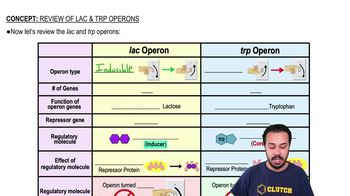
Review of the Lac Operon & Trp Operon

Repressor Proteins

Repressor proteins are molecules that bind to specific DNA sequences, preventing the transcription of certain genes. In the context of the trp operon, the repressor is inactive without the corepressor (tryptophan) and becomes active when the corepressor is present, thus inhibiting gene expression by binding to the operator region.
Recommended video:

Corepressors

Corepressors are small molecules that enhance the function of repressor proteins. In the trp operon, tryptophan acts as a corepressor by binding to the repressor protein, which then attaches to the operator to inhibit transcription. This mechanism ensures that the production of tryptophan is halted when it is abundant, conserving cellular resources.
Recommended video:
Guided course
03:42
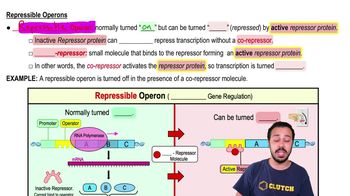
Repressible Operons