
Pearson+ LogoPearson+ Logo
Ch. 53 - Population Ecology
Campbell - Campbell Biology 12th Edition
Urry12th EditionCampbell BiologyISBN: 9785794169850Not the one you use?Change textbook
Chapter 53, Problem 4

Analyzing ecological footprints reveals that
a. Earth's carrying capacity would increase if per capita meat consumption increased.
b. Current demand by industrialized countries for resources is much smaller than the ecological footprint of those countries.
c. It is not possible for technological improvements to increase Earth's carrying capacity for humans.
d. The ecological footprint of the United States is large because per capita resource use is high.

Verified step by step guidance
1
Understand the concept of ecological footprint: It measures the amount of natural resources an individual, community, or country consumes compared to what the Earth can regenerate. It includes factors like food consumption, energy use, and waste production.
Analyze Earth's carrying capacity: This refers to the maximum population size that the environment can sustain indefinitely, given the food, habitat, water, and other necessities available in the environment.
Evaluate the impact of per capita meat consumption: Increased meat consumption generally requires more resources, such as land and water, for livestock farming, which can affect the ecological footprint and carrying capacity.
Consider the role of technological improvements: Technological advancements can potentially increase Earth's carrying capacity by improving resource efficiency, reducing waste, and developing sustainable practices.
Assess the ecological footprint of the United States: The United States has a large ecological footprint due to high per capita resource use, including energy consumption, transportation, and food production, which contributes to its overall environmental impact.

Verified video answer for a similar problem:

This video solution was recommended by our tutors as helpful for the problem above.
Video duration:
2m
Was this helpful?

Key Concepts

Here are the essential concepts you must grasp in order to answer the question correctly.

Ecological Footprint

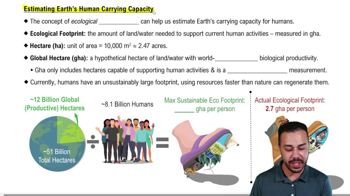
The ecological footprint measures the demand on Earth's ecosystems and compares human consumption of natural resources with the planet's ability to regenerate them. It is expressed in global hectares and reflects the amount of biologically productive land and water area required to produce the resources consumed and to absorb the waste generated by a population.
Recommended video:

Carrying Capacity

Carrying capacity refers to the maximum number of individuals or species an environment can support without degrading the ecosystem. It is influenced by resource availability, environmental conditions, and technological advancements. Understanding carrying capacity helps in assessing the sustainability of human activities and their impact on the planet.
Recommended video:
Guided course
06:24
Estimating Earth’s Human Carrying Capacity

Per Capita Resource Use

Per capita resource use is the average amount of resources consumed by an individual within a population. It includes energy, water, food, and other materials necessary for daily life. High per capita resource use, especially in industrialized countries, contributes to a larger ecological footprint, indicating greater environmental impact and resource demand.
Recommended video:
Guided course
03:26
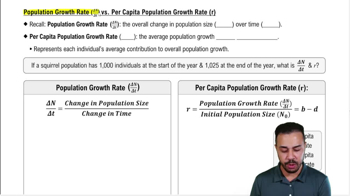
Population Growth Rate vs. Per Capita Population Growth Rate
Related Practice
Textbook Question

Population ecologists follow the fate of same-age cohorts to

a. Determine a population's carrying capacity

b. Determine the birth rate and death rate of each group in a population

c. Determine if a population is regulated by density-dependent processes

d. Determine the factors that affect the size of a population

Textbook Question

A population's carrying capacity

a. May change as environmental conditions change

b. Can be accurately calculated using the logistic growth model

c. Increases as the per capita population growth rate decreases

d. Can never be exceeded

Textbook Question

Scientific study of the population cycles of the snowshoe hare and its predator, the lynx has revealed that

a. Predation is the dominant factor affecting prey population cycling.

b. Hares and lynx are so mutually dependent that each species cannot survive without the other.

c. Both hare and lynx population sizes are affected mainly by abiotic factors.

d. The hare population is r-selected and the lynx population is K-selected.

Textbook Question

Based on current growth rates, Earth's human population in 2019 will be closest to

a. 2.5 million

b. 4.5 billion

c. 7.5 billion

d. 10.5 billion

Textbook Question

The observation that members of a population are uniformly distributed suggests that

a. Resources are distributed unevenly.

b. The members of the population are competing for access to a resource.

c. The members of the population are neither attracted to nor repelled by one another.

d. The density of the population is low.

Textbook Question

According to the logistic growth equation


dNdt=rN(KN)K\frac{dN}{dt}=rN\frac{\left(K-N\right)}{K}


a. The number of individuals added per unit time is greatest when N is close to zero.

b. The per capita population growth rate increases as N approaches K.

c. Population growth is zero when N equals K.

d. The population grows exponentially when K is small.

1
views