
Pearson+ LogoPearson+ Logo
Ch. 53 - Population Ecology
Campbell - Campbell Biology 12th Edition
Urry12th EditionCampbell BiologyISBN: 9785794169850Not the one you use?Change textbook
Chapter 53, Problem 7

According to the logistic growth equation


dNdt=rN(KN)K\frac{dN}{dt}=rN\frac{\left(K-N\right)}{K}


a. The number of individuals added per unit time is greatest when N is close to zero.
b. The per capita population growth rate increases as N approaches K.
c. Population growth is zero when N equals K.
d. The population grows exponentially when K is small.

Verified step by step guidance
1
Understand the logistic growth equation: \( \frac{dN}{dt} = rN \frac{(K-N)}{K} \), where \( N \) is the population size, \( r \) is the intrinsic rate of increase, and \( K \) is the carrying capacity.
Identify the condition for zero population growth: Set \( \frac{dN}{dt} = 0 \). This occurs when \( N = K \), meaning the population size equals the carrying capacity.
Analyze the per capita growth rate: The per capita growth rate is \( r \frac{(K-N)}{K} \). As \( N \) approaches \( K \), \( \frac{(K-N)}{K} \) approaches zero, thus the per capita growth rate decreases.
Consider when the number of individuals added per unit time is greatest: This occurs when \( N \) is at half the carrying capacity, \( N = \frac{K}{2} \), not when \( N \) is close to zero.
Evaluate the condition for exponential growth: Exponential growth occurs when \( K \) is very large or effectively infinite, not when \( K \) is small. In the logistic model, exponential growth is not dependent on the size of \( K \).

Verified video answer for a similar problem:

This video solution was recommended by our tutors as helpful for the problem above.
Video duration:
2m
Was this helpful?

Key Concepts

Here are the essential concepts you must grasp in order to answer the question correctly.

Logistic Growth Equation

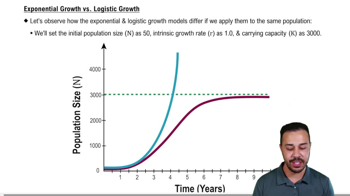
The logistic growth equation models population growth by incorporating the carrying capacity (K), which limits growth as the population size (N) approaches K. It is expressed as dN/dt = rN(K−N)/K, where r is the intrinsic growth rate. This equation reflects how growth slows as resources become limited, contrasting with exponential growth where resources are unlimited.
Recommended video:
Guided course
09:46
Exponential Growth vs. Logistic Growth

Carrying Capacity (K)

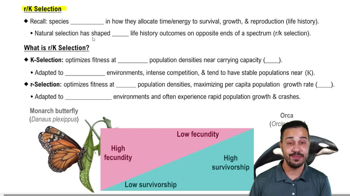
Carrying capacity (K) is the maximum population size that an environment can sustain indefinitely without degrading the habitat. It is determined by available resources such as food, habitat, water, and other necessities. In the logistic growth model, as N approaches K, the growth rate decreases, eventually reaching zero when N equals K, indicating a stable population.
Recommended video:
Guided course
04:08
r/K Selection

Per Capita Growth Rate

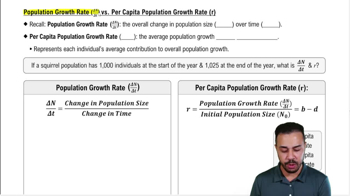
Per capita growth rate refers to the average individual contribution to population growth. In the logistic model, this rate decreases as the population size (N) nears the carrying capacity (K) due to increased competition for limited resources. Initially, when N is small, the per capita growth rate is higher, but it diminishes as the population grows and resources become scarce.
Recommended video:
Guided course
03:26
Population Growth Rate vs. Per Capita Population Growth Rate