Pearson+ LogoPearson+ Logo
Ch. 36 - Resource Acquisition and Transport in Vascular Plants
Campbell - Campbell Biology 12th Edition
Urry12th EditionCampbell BiologyISBN: 9785794169850Not the one you use?Change textbook
Chapter 36, Problem 2

Which structure or compartment is part of the symplast?
a. The interior of a vessel element
b. The interior of a sieve tube
c. The cell wall of a mesophyll cell
d. An extracellular air space

Verified step by step guidance
1
Understand the concept of symplast: The symplast is the network of cytoplasm interconnected by plasmodesmata, allowing direct cytoplasmic communication between plant cells.
Identify the structures involved: The symplast includes the cytoplasm of cells connected by plasmodesmata, not the cell walls or extracellular spaces.
Evaluate option a: The interior of a vessel element is part of the apoplast, not the symplast, as vessel elements are dead cells and do not have cytoplasm.
Evaluate option b: The interior of a sieve tube is part of the symplast, as sieve tubes are living cells connected by plasmodesmata, allowing cytoplasmic continuity.
Evaluate options c and d: The cell wall of a mesophyll cell and an extracellular air space are part of the apoplast, as they are outside the cytoplasm and not connected by plasmodesmata.

Verified video answer for a similar problem:

This video solution was recommended by our tutors as helpful for the problem above.
Video duration:
1m
Was this helpful?

Key Concepts

Here are the essential concepts you must grasp in order to answer the question correctly.

Symplast

The symplast refers to the interconnected network of cytoplasm in plant cells, connected by plasmodesmata. It allows for the direct flow of substances between cells without crossing the cell membrane, facilitating communication and transport within the plant. Understanding the symplast is crucial for identifying structures involved in intracellular transport.
Recommended video:
Guided course
07:59
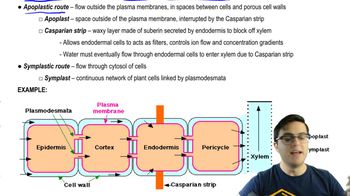
How Water Enters Xylem

Plasmodesmata

Plasmodesmata are microscopic channels that traverse the cell walls of plant cells, linking the cytoplasm of adjacent cells. They play a vital role in the symplast by enabling the movement of ions, molecules, and signaling substances between cells, thus maintaining the plant's internal connectivity and coordination.
Recommended video:
Guided course
05:33
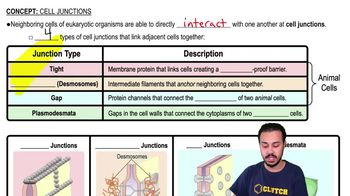
Cell Junctions

Sieve Tube Elements

Sieve tube elements are specialized cells in the phloem of vascular plants, responsible for transporting nutrients like sugars throughout the plant. These cells are part of the symplast, as they are connected by plasmodesmata, allowing for the efficient flow of substances within the plant's vascular system, crucial for understanding nutrient distribution.
Recommended video:
Guided course
03:36
Elements of Life