Pearson+ LogoPearson+ Logo
Ch. 36 - Resource Acquisition and Transport in Vascular Plants
Campbell - Campbell Biology 12th Edition
Urry12th EditionCampbell BiologyISBN: 9785794169850Not the one you use?Change textbook
Chapter 36, Problem 8

Which of the following would tend to increase transpiration?
a. Spiny leaves
b. Sunken stomata
c. A thicker cuticle
d. Higher stomatal density

Verified step by step guidance
1
Understand the concept of transpiration: Transpiration is the process by which water is absorbed by plant roots, moves through plants, and is released as vapor through stomata in leaves.
Identify factors affecting transpiration: Transpiration is influenced by environmental conditions and leaf characteristics, such as stomatal density, leaf surface area, and cuticle thickness.
Analyze the options: Consider how each option affects transpiration. Spiny leaves, sunken stomata, and a thicker cuticle generally reduce water loss, while higher stomatal density increases the surface area for water vapor to escape.
Focus on stomatal density: Higher stomatal density means more stomata per unit area, which can increase the rate of transpiration by providing more openings for water vapor to exit.
Conclude which option increases transpiration: Based on the analysis, higher stomatal density would tend to increase transpiration compared to the other options.

Verified video answer for a similar problem:

This video solution was recommended by our tutors as helpful for the problem above.
Video duration:
39s
Was this helpful?

Key Concepts

Here are the essential concepts you must grasp in order to answer the question correctly.

Transpiration

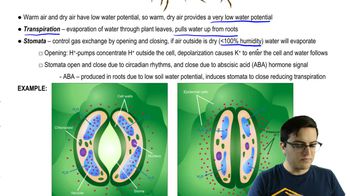
Transpiration is the process by which water is absorbed by plant roots, moves through plants, and is released as water vapor through stomata in leaves. It plays a crucial role in nutrient uptake, cooling the plant, and maintaining water balance. Factors affecting transpiration include temperature, humidity, wind, and stomatal characteristics.
Recommended video:
Guided course
08:29
Water Potential in Soil and Air

Stomatal Density

Stomatal density refers to the number of stomata per unit area on a leaf surface. Higher stomatal density increases the potential for gas exchange, including water vapor release, thus enhancing transpiration rates. Plants may adjust stomatal density in response to environmental conditions to optimize water use efficiency.
Recommended video:
Guided course
05:43
Density of Liquid Water vs. Solid Ice

Leaf Adaptations

Leaf adaptations such as spiny leaves, sunken stomata, and thicker cuticles are strategies plants use to reduce water loss. Spiny leaves reduce surface area, sunken stomata minimize exposure to air currents, and thicker cuticles provide a barrier to water loss. These adaptations are typically found in arid environments to conserve water.
Recommended video:
Guided course
08:18
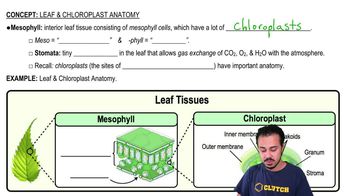
Leaf & Chloroplast Anatomy