Pearson+ LogoPearson+ Logo
Ch. 35 - Vascular Plant Structure, Growth, and Development
Campbell - Campbell Biology 12th Edition
Urry12th EditionCampbell BiologyISBN: 9785794169850Not the one you use?Change textbook
Chapter 35, Problem 9

Which of the following arise(s), directly or indirectly, from meristematic activity?
a. Secondary xylem
b. Leaves
c. Dermal tissue
d. All of the above

Verified step by step guidance
1
Understand what meristematic activity is: Meristematic cells are undifferentiated cells in plants that have the ability to divide and differentiate into various types of plant tissues. They are responsible for the growth and development of plants.
Identify the types of meristems: There are two main types of meristems - apical meristems, which are found at the tips of roots and shoots and are responsible for primary growth, and lateral meristems, which are responsible for secondary growth.
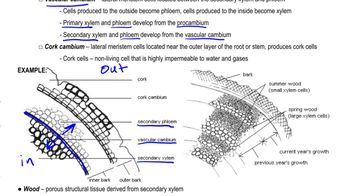
Consider secondary xylem: Secondary xylem is produced by the activity of the lateral meristem known as the vascular cambium. It contributes to the thickening of stems and roots.
Consider leaves: Leaves arise from the activity of apical meristems, which contribute to the formation of new shoots and leaves during primary growth.
Consider dermal tissue: Dermal tissue, which includes the epidermis, arises from the differentiation of meristematic cells during both primary and secondary growth processes.

Verified video answer for a similar problem:

This video solution was recommended by our tutors as helpful for the problem above.
Video duration:
51s
Was this helpful?

Key Concepts

Here are the essential concepts you must grasp in order to answer the question correctly.

Meristematic Activity

Meristematic activity refers to the process by which meristem cells, which are undifferentiated and capable of continuous division, contribute to plant growth. These cells are found in specific regions like the tips of roots and shoots, and they give rise to various tissues and organs, enabling primary and secondary growth in plants.
Recommended video:
Guided course
02:37
Active Transport

Secondary Xylem

Secondary xylem is a type of vascular tissue that forms as a result of secondary growth, primarily from the activity of the vascular cambium, a lateral meristem. It is responsible for transporting water and nutrients and contributes to the thickening of stems and roots, commonly seen in woody plants as part of the wood.
Recommended video:
Guided course
06:53
Secondary Growth

Dermal Tissue

Dermal tissue is the outer protective layer of a plant, arising from the activity of meristematic cells. It includes structures like the epidermis and periderm, which protect against physical damage and water loss. This tissue plays a crucial role in interfacing with the environment and is essential for plant survival.
Recommended video:
Guided course
06:58
Vascular Tissue