Pearson+ LogoPearson+ Logo
Ch. 35 - Vascular Plant Structure, Growth, and Development
Campbell - Campbell Biology 12th Edition
Urry12th EditionCampbell BiologyISBN: 9785794169850Not the one you use?Change textbook
Chapter 35, Problem 5

The vascular cambium gives rise to
a. All xylem
b. All phloem
c. Primary xylem and phloem
d. Secondary xylem and phloem

Verified step by step guidance
1
Understand the role of the vascular cambium: The vascular cambium is a type of lateral meristem in plants responsible for the production of secondary growth, which increases the thickness of stems and roots.
Differentiate between primary and secondary growth: Primary growth occurs at the apical meristems and results in the elongation of the plant, while secondary growth, facilitated by the vascular cambium, results in the thickening of the plant.
Identify the products of the vascular cambium: The vascular cambium produces secondary xylem (wood) and secondary phloem, contributing to the plant's increased girth.
Clarify the distinction between primary and secondary tissues: Primary xylem and phloem are produced by the apical meristems during primary growth, whereas secondary xylem and phloem are produced by the vascular cambium during secondary growth.
Conclude which option is correct: Based on the understanding that the vascular cambium produces secondary xylem and phloem, identify the correct answer from the given options.

Verified video answer for a similar problem:

This video solution was recommended by our tutors as helpful for the problem above.
Video duration:
1m
Was this helpful?

Key Concepts

Here are the essential concepts you must grasp in order to answer the question correctly.

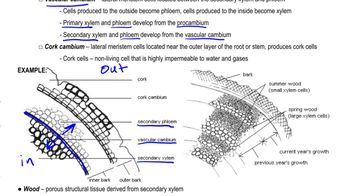
Vascular Cambium

The vascular cambium is a type of lateral meristem in plants responsible for the production of secondary vascular tissues. It is a cylindrical layer of cells that divides to produce secondary xylem (wood) on the inside and secondary phloem on the outside, contributing to the thickening of stems and roots in woody plants.
Recommended video:
Guided course
06:08
Seedless Vascular Plants

Secondary Growth

Secondary growth refers to the increase in thickness or girth of plant stems and roots, primarily in woody plants. This growth is facilitated by the vascular cambium and cork cambium, which produce secondary xylem and phloem, and cork, respectively. Secondary growth is crucial for the structural support and transport of nutrients and water in mature plants.
Recommended video:
Guided course
06:53
Secondary Growth

Primary vs. Secondary Xylem and Phloem

Primary xylem and phloem are formed during the initial growth phase from the apical meristems, contributing to the elongation of the plant. In contrast, secondary xylem and phloem are produced by the vascular cambium during secondary growth, increasing the plant's thickness. Understanding the distinction is essential for identifying the roles of different plant tissues in growth and nutrient transport.
Recommended video:
Guided course
06:14
Primary and Secondary Immunity