Pearson+ LogoPearson+ Logo
Ch. 28 - Protists
Campbell - Campbell Biology 12th Edition
Urry12th EditionCampbell BiologyISBN: 9785794169850Not the one you use?Change textbook
Chapter 28, Problem 4

According to the phylogeny, which protists are in the same eukaryotic supergroup as plants?
a. Green algae
b. Dinoflagellates
c. Red algae
d. Both A and C

Verified step by step guidance
1
Understand the concept of eukaryotic supergroups: Eukaryotic organisms are classified into several supergroups based on genetic and morphological characteristics. Plants belong to the supergroup called Archaeplastida.
Identify the protists that belong to the Archaeplastida supergroup: Green algae and red algae are both part of the Archaeplastida supergroup, which includes plants.
Examine the options provided in the problem: The options are green algae (a), dinoflagellates (b), red algae (c), and both A and C (d).
Determine which options belong to the same supergroup as plants: Since both green algae and red algae are part of the Archaeplastida supergroup, they are in the same supergroup as plants.
Select the correct answer based on the analysis: The correct answer is option d, both A and C, as both green algae and red algae are in the same eukaryotic supergroup as plants.

Verified video answer for a similar problem:

This video solution was recommended by our tutors as helpful for the problem above.
Video duration:
1m
Was this helpful?

Key Concepts

Here are the essential concepts you must grasp in order to answer the question correctly.

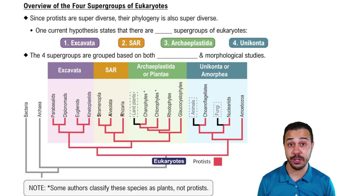
Eukaryotic Supergroups

Eukaryotic supergroups are large clades that categorize eukaryotic organisms based on genetic and evolutionary relationships. These groups help in understanding the diversity and evolutionary history of eukaryotes, including plants, animals, fungi, and protists. Identifying which organisms belong to the same supergroup can reveal shared characteristics and ancestral traits.
Recommended video:
Guided course
03:01
Overview of the Four Supergroups of Eukaryotes

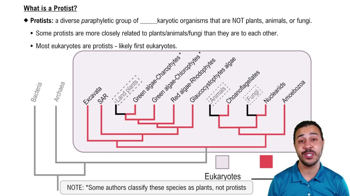
Protists

Protists are a diverse group of eukaryotic microorganisms that are not classified as plants, animals, or fungi. They include various types of algae, protozoa, and slime molds. Understanding protists is crucial for studying evolutionary biology, as they often share characteristics with other eukaryotic groups and can provide insights into the evolution of complex life forms.
Recommended video:
Guided course
03:23
What is a Protist?

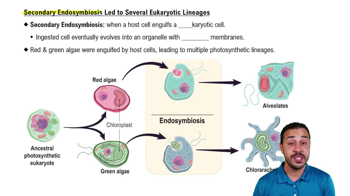
Green and Red Algae

Green and red algae are types of protists that belong to the Archaeplastida supergroup, which also includes land plants. Green algae are closely related to plants and share many characteristics, such as chlorophyll types and photosynthetic processes. Red algae are distinct but still part of the same supergroup, highlighting the evolutionary link between these protists and plants.
Recommended video:
Guided course
02:37
Secondary Endosymbiosis Led to Several Eukaryotic Lineages
Related Practice
Textbook Question

Plastids that are surrounded by more than two membranes are evidence of

a. Evolution from mitochondria.

b. Fusion of plastids.

c. Origin of the plastids from archaea.

d. Secondary endosymbiosis.

Textbook Question

Biologists think that endosymbiosis gave rise to mitochondria before plastids partly because

a. The products of photosynthesis could not be metabolized without mitochondrial enzymes.

b. All eukaryotes have mitochondria (or their remnants), whereas many eukaryotes do not have plastids.

c. Mitochondrial DNA is less similar to prokaryotic DNA than is plastid DNA.

d. Without mitochondrial CO2 production, photosynthesis could not occur.

Textbook Question

Which group is correctly paired with its description?


A. diatoms—important consumers in aquatic communities

B. diplomonads—protists with modified mitochondria

C. apicomplexans—producers with intricate life cycles

D. red algae—acquired plastids by secondary endosymbiosis


Textbook Question

In a life cycle with alternation of generations, multicellular haploid forms alternate with

a. Unicellular haploid forms

b. Unicellular diploid forms

c. Multicellular haploid forms

d. Multicellular diploid forms

2
views
Textbook Question

Based on the phylogenetic tree in Figure 28.5, which of the following statements is correct?

a. Excavata and SAR form a sister group

b. The most recent common ancestor of SAR is older than that of Unikonta

c. The most basal (first to diverge) eukaryotic supergroup cannot be determined

d. Excavata is the most basal eukaryotic supergroup

Textbook Question

Medical researchers seek to develop drugs that can kill or restrict the growth of human pathogens yet have few harmful effects on patients. These drugs often work by disrupting the metabolism of the pathogen or by targeting its structural features.

Draw and label a phylogenetic tree that includes an ancestral prokaryote and the following groups of organisms: Excavata, SAR, Archaeplastida, Unikonta, and, within Unikonta, amoebozoans, animals, choanoflagellates, fungi, and nucleariids. Based on this tree, hypothesize whether it would be most difficult to develop drugs to combat human pathogens that are prokaryotes, protists, animals, or fungi. (You do not need to consider the evolution of drug resistance by the pathogen.)

1
views