Pearson+ LogoPearson+ Logo
Ch. 25 - The History of Life on Earth
Campbell - Campbell Biology 12th Edition
Urry12th EditionCampbell BiologyISBN: 9785794169850Not the one you use?Change textbook
Chapter 25, Problem 3

Which factor most likely caused animals and plants in India to differ greatly from species in nearby Southeast Asia?
a. The species became separated by convergent evolution.
b. The climates of the two regions are similar.
c. India is in the process of separating from the rest of Asia.
d. India was a separate continent until 45 million years ago.

Verified step by step guidance
1
Understand the concept of biogeography, which studies the distribution of species and ecosystems in geographic space and through geological time.
Recognize that geographic isolation is a key factor in the evolution of species. When land masses are separated, species on each land mass evolve independently.
Consider the geological history of India. India was once a separate landmass and only collided with Asia around 45 million years ago, which could lead to distinct evolutionary paths for species.
Evaluate the options given in the problem. Convergent evolution (option a) refers to different species evolving similar traits independently, which does not explain geographic separation. Similar climates (option b) would likely lead to similar species, not different ones. The process of separation (option c) is ongoing but does not explain historical differences.
Conclude that the historical separation of India as a separate continent (option d) is the most likely factor causing the distinct species differences between India and Southeast Asia.

Verified video answer for a similar problem:

This video solution was recommended by our tutors as helpful for the problem above.
Video duration:
2m
Was this helpful?

Key Concepts

Here are the essential concepts you must grasp in order to answer the question correctly.

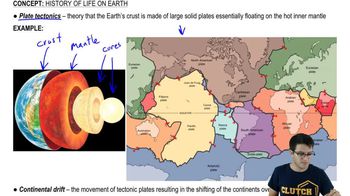
Plate Tectonics

Plate tectonics is the theory explaining the movement of Earth's lithospheric plates. It accounts for the historical separation and collision of landmasses, such as India's drift from Gondwana and its eventual collision with Asia. This movement has led to distinct evolutionary paths for species on different continents.
Recommended video:
Guided course
04:33
Plate Tectonics and Continental Drift

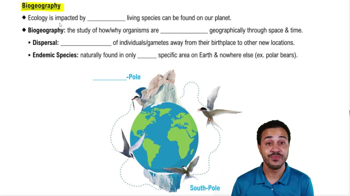
Biogeography

Biogeography studies the distribution of species and ecosystems in geographic space and through geological time. It helps explain why species in India differ from those in Southeast Asia due to historical land separations and unique evolutionary pressures, resulting in distinct flora and fauna.
Recommended video:

Evolutionary Isolation

Evolutionary isolation occurs when populations are geographically separated, leading to independent evolutionary paths. India's historical isolation as a separate continent allowed its species to evolve differently from those in Southeast Asia, resulting in significant biodiversity differences.
Recommended video:
02:45
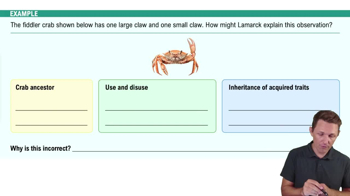
History of Evolutionary Theory Example 1
Related Practice
Textbook Question

Fossilized stromatolites:

a. Formed around deep-sea vents.

b. Resemble structures formed by bacterial communities that are found today in some shallow marine bays.

c. Provide evidence that plants moved onto land in the company of fungi around 500 million years ago.

d. Contain the first undisputed fossils of eukaryotes.

1
views
Textbook Question

The oxygen revolution changed Earth's environment dramatically. Which of the following took advantage of the presence of free oxygen in the oceans and atmosphere?

a. The evolution of cellular respiration, which used oxygen to help harvest energy from organic molecules

b. The persistence of some animal groups in anaerobic habitats

c. The evolution of photosynthetic pigments that protected early algae from the corrosive effects of oxygen

d. The evolution of chloroplasts after early protists incorporated photosynthetic cyanobacteria

Textbook Question
Large-scale, worldwide adaptive radiations have occurred in which of the following situations?(A)when there are no available ecological niches(B)after each of the big five mass extinctions(C)after colonization of an isolated island that contains suit-able habitat and few competitor species(D)whenever an evolutionary innovation was needed for or-ganisms to thrive
1
views
Textbook Question

Large-scale, worldwide adaptive radiations have occurred in which of the following situations?

a. When there are no available ecological niches

b. After each of the big five mass extinctions

c. Aafter colonization of an isolated island that contains suitable habitat and few competitor species

d. Whenever an evolutionary innovation was needed for organisms to thrive

Textbook Question
Scientists studying the origin of life have accomplished which of the following steps?(A)abiotic synthesis of protocells with self-replicating, catalytic RNA(B)formation of vesicles that use RNA as a template for DNA synthesis(C)formation of protocells that use DNA to direct the polymer-ization of amino acids(D)abiotic synthesis of RNA's bases (A, C, G, U)