Pearson+ LogoPearson+ Logo
Ch. 17 - Gene Expression: From Gene to Protein
Campbell - Campbell Biology 12th Edition
Urry12th EditionCampbell BiologyISBN: 9785794169850Not the one you use?Change textbook
Chapter 17, Problem 8

Would the coupling of the processes shown in Figure 17.24 be found in a eukaryotic cell? Explain why or why not.
<IMAGE>

Verified step by step guidance
1
Begin by identifying the processes shown in Figure 17.24. Typically, this figure might depict processes such as transcription and translation, which are key steps in gene expression.
Understand the location of these processes in eukaryotic cells. Transcription occurs in the nucleus, where DNA is transcribed into mRNA. Translation occurs in the cytoplasm, where ribosomes synthesize proteins from mRNA.
Consider the concept of coupling in cellular processes. In prokaryotic cells, transcription and translation can be coupled, meaning they occur simultaneously in the cytoplasm. However, in eukaryotic cells, these processes are separated by the nuclear membrane.
Evaluate the implications of this separation. The nuclear membrane in eukaryotic cells prevents the direct coupling of transcription and translation, as mRNA must be processed and transported out of the nucleus before translation can occur.
Conclude by explaining why coupling of these processes, as shown in the figure, would not be found in eukaryotic cells due to the spatial and temporal separation imposed by the nuclear membrane.

Verified video answer for a similar problem:

This video solution was recommended by our tutors as helpful for the problem above.
Video duration:
41s
Was this helpful?

Key Concepts

Here are the essential concepts you must grasp in order to answer the question correctly.

Coupling of Transcription and Translation

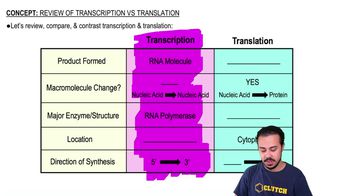
In prokaryotic cells, transcription and translation are coupled, meaning they occur simultaneously in the cytoplasm. This is possible because prokaryotes lack a nucleus, allowing ribosomes to begin translating mRNA as it is being transcribed. In eukaryotic cells, transcription occurs in the nucleus, and translation occurs in the cytoplasm, preventing direct coupling.
Recommended video:
Guided course
04:07
Review of Transcription vs. Translation

Eukaryotic Cell Compartmentalization

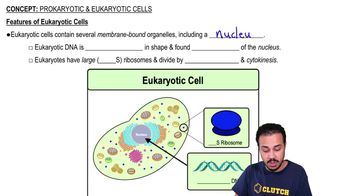
Eukaryotic cells are characterized by compartmentalization, with distinct organelles such as the nucleus and cytoplasm. This separation means that transcription occurs in the nucleus, where DNA is housed, and mRNA must be processed and transported to the cytoplasm for translation, preventing simultaneous transcription and translation.
Recommended video:
Guided course
04:17
Features of Eukaryotic Cells

mRNA Processing in Eukaryotes

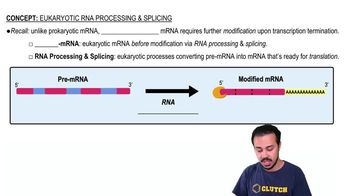
In eukaryotic cells, mRNA undergoes several processing steps before translation, including capping, polyadenylation, and splicing. These modifications are necessary for mRNA stability and export from the nucleus to the cytoplasm. This processing further separates transcription and translation temporally and spatially, unlike in prokaryotes.
Recommended video:
Guided course
02:32
Eukaryotic RNA Processing and Splicing