Pearson+ LogoPearson+ Logo
Ch. 12 - The Cell Cycle
Campbell - Campbell Biology 12th Edition
Urry12th EditionCampbell BiologyISBN: 9785794169850Not the one you use?Change textbook
Chapter 12, Problem 8

The drug cytochalasin B blocks the function of actin. Which of the following aspects of the animal cell cycle would be most disrupted by cytochalasin B?
a. Spindle formation
b. Spindle attachment to kinetochores
c. Cell elongation during anaphase
d. Cleavage furrow formation and cytokinesis

Verified step by step guidance
1
Understand the role of actin in the cell cycle. Actin is a protein that forms microfilaments, which are part of the cytoskeleton and play a crucial role in various cellular processes, including cytokinesis.
Identify the process in the cell cycle that directly involves actin. During cytokinesis, actin filaments form a contractile ring at the site of the cleavage furrow, which helps in dividing the cell into two daughter cells.
Evaluate each option in the context of actin's function: a) Spindle formation primarily involves microtubules, not actin. b) Spindle attachment to kinetochores is also related to microtubules. c) Cell elongation during anaphase is driven by microtubules. d) Cleavage furrow formation and cytokinesis directly involve actin filaments.
Recognize that cytochalasin B disrupts actin function, which would most affect processes that rely on actin, such as the formation of the cleavage furrow during cytokinesis.
Conclude that the aspect of the animal cell cycle most disrupted by cytochalasin B is cleavage furrow formation and cytokinesis, as this process is dependent on actin filaments.

Verified video answer for a similar problem:

This video solution was recommended by our tutors as helpful for the problem above.
Video duration:
46s
Was this helpful?

Key Concepts

Here are the essential concepts you must grasp in order to answer the question correctly.

Actin Function in Cells

Actin is a crucial protein that forms microfilaments, part of the cytoskeleton in eukaryotic cells. It plays a significant role in maintaining cell shape, enabling cell movement, and facilitating cell division, particularly during cytokinesis. Actin filaments are essential for forming the contractile ring that leads to the cleavage furrow, which is vital for the physical separation of dividing cells.
Recommended video:
Guided course
05:33
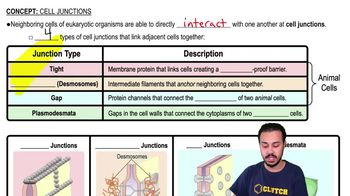
Cell Junctions

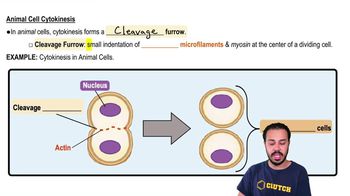
Cytokinesis in Animal Cells

Cytokinesis is the process during cell division where the cytoplasm of a single eukaryotic cell is divided to form two daughter cells. In animal cells, this involves the formation of a cleavage furrow, which is driven by a contractile ring composed of actin and myosin filaments. The contractile ring constricts the cell membrane, leading to the physical separation of the two new cells.
Recommended video:
Guided course
02:56
Animal Cell Cytokinesis

Role of Actin in Cleavage Furrow Formation

The cleavage furrow is an indentation that begins the process of cytokinesis in animal cells. Actin filaments, along with myosin, form a contractile ring beneath the plasma membrane at the site of the furrow. This ring contracts, pulling the membrane inward and eventually pinching the cell into two separate entities. Disruption of actin function, such as by cytochalasin B, would impede this process, preventing successful cytokinesis.
Recommended video:
Guided course
02:56
Animal Cell Cytokinesis