Pearson+ LogoPearson+ Logo
Ch. 12 - The Cell Cycle
Campbell - Campbell Biology 12th Edition
Urry12th EditionCampbell BiologyISBN: 9785794169850Not the one you use?Change textbook
Chapter 12, Problem 5a

In the cells of some organisms, mitosis occurs without cytokinesis. This will result in
a. Cells with more than one nucleus
b. Cells that are unusually small
c. Cells lacking nuclei
d. Cell cycles lacking an S phase

Verified step by step guidance
1
Understand the key terms in the problem: Mitosis is the process of nuclear division, where the genetic material is divided into two nuclei. Cytokinesis is the division of the cytoplasm, resulting in two separate cells. If cytokinesis does not occur, the cytoplasm is not divided, but mitosis still produces multiple nuclei within a single cell.
Analyze the options provided: a) Cells with more than one nucleus, b) Cells that are unusually small, c) Cells lacking nuclei, d) Cell cycles lacking an S phase. Consider the biological implications of mitosis without cytokinesis for each option.
Eliminate incorrect options: Option b (cells that are unusually small) is incorrect because the size of the cell is not directly affected by the absence of cytokinesis. Option c (cells lacking nuclei) is incorrect because mitosis ensures the formation of nuclei. Option d (cell cycles lacking an S phase) is incorrect because the S phase, where DNA replication occurs, is a prerequisite for mitosis and is not skipped.
Focus on the correct option: If mitosis occurs without cytokinesis, the result is a single cell containing multiple nuclei, as the nuclei divide but the cytoplasm does not separate into individual cells.
Conclude that the correct answer is option a (Cells with more than one nucleus), as this is the direct result of mitosis without cytokinesis.

Verified video answer for a similar problem:

This video solution was recommended by our tutors as helpful for the problem above.
Video duration:
4m
Was this helpful?

Key Concepts

Here are the essential concepts you must grasp in order to answer the question correctly.

Mitosis

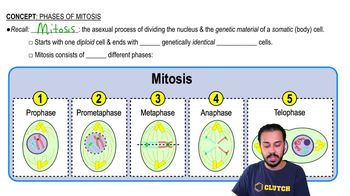
Mitosis is the process of cell division where a single cell divides to produce two genetically identical daughter cells. It involves several stages: prophase, metaphase, anaphase, and telophase, which ensure that the duplicated chromosomes are evenly distributed. Understanding mitosis is crucial for recognizing how cells replicate and maintain genetic continuity.
Recommended video:
Guided course
03:21
Phases of Mitosis

Cytokinesis

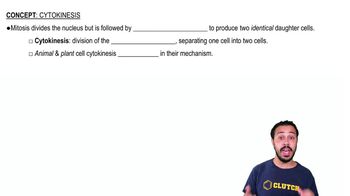
Cytokinesis is the final step of cell division, occurring after mitosis, where the cytoplasm of a parental cell divides into two daughter cells. In some organisms, cytokinesis may not occur, leading to the formation of multinucleated cells. This process is essential for ensuring that each daughter cell receives the necessary cellular components and organelles.
Recommended video:

Multinucleation

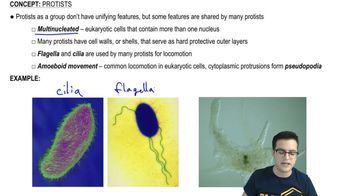
Multinucleation refers to the presence of multiple nuclei within a single cell, which can occur when mitosis happens without cytokinesis. This phenomenon is observed in certain organisms and cell types, such as muscle fibers and some fungi, and can affect cellular function and growth. Understanding multinucleation helps explain the implications of abnormal cell division.
Recommended video:
Guided course
07:30
Protist Cells 3