Pearson+ LogoPearson+ Logo
Ch. 10 - Photosynthesis
Campbell - Campbell Biology 12th Edition
Urry12th EditionCampbell BiologyISBN: 9785794169850Not the one you use?Change textbook
Chapter 10, Problem 7

Which process is most directly driven by light energy?
a. Creation of a pH gradient by pumping protons across the thylakoid membrane
b. Reduction of NADP+ molecules
c. Transfer of energy from pigment molecule to pigment molecule
d. ATP synthesis

Verified step by step guidance
1
Understand that the question is about photosynthesis, which is the process plants use to convert light energy into chemical energy.
Identify the role of light energy in photosynthesis. Light energy is primarily absorbed by chlorophyll and other pigments in the chloroplasts.
Recognize that the absorbed light energy excites electrons in the chlorophyll molecules, which is the initial step in the light-dependent reactions of photosynthesis.
Consider each option: (a) involves the creation of a proton gradient, (b) involves the reduction of NADP+, (c) involves the transfer of energy between pigment molecules, and (d) involves ATP synthesis.
Determine that the process most directly driven by light energy is the transfer of energy from pigment molecule to pigment molecule, as this is the immediate result of light absorption, leading to the excitation of electrons.

Verified video answer for a similar problem:

This video solution was recommended by our tutors as helpful for the problem above.
Video duration:
1m
Was this helpful?

Key Concepts

Here are the essential concepts you must grasp in order to answer the question correctly.

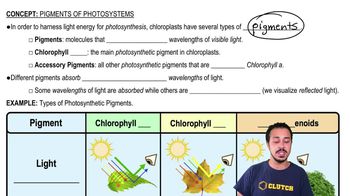
Photosynthesis

Photosynthesis is the process by which green plants, algae, and some bacteria convert light energy into chemical energy stored in glucose. It occurs in the chloroplasts and involves two main stages: the light-dependent reactions and the Calvin cycle. Light energy is captured by chlorophyll and other pigments, driving the synthesis of ATP and NADPH, which are used in the Calvin cycle to produce glucose.
Recommended video:
Guided course
05:58
Pigments of Photosynthesis

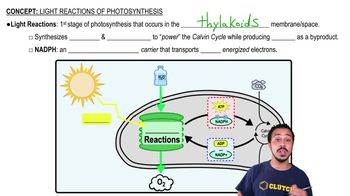
Light-Dependent Reactions

The light-dependent reactions are the first stage of photosynthesis, occurring in the thylakoid membranes of chloroplasts. These reactions require light energy to excite electrons in chlorophyll, leading to the production of ATP and NADPH. The process involves the transfer of energy between pigment molecules and the creation of a proton gradient across the thylakoid membrane, which drives ATP synthesis.
Recommended video:
Guided course
04:06
Light Reactions of Photosynthesis

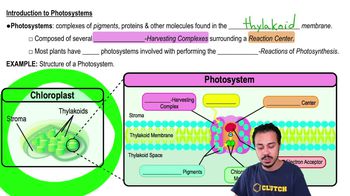
Energy Transfer in Photosystems

Energy transfer in photosystems involves the movement of energy from one pigment molecule to another within the thylakoid membrane. This process is initiated by the absorption of light energy, which excites electrons in chlorophyll molecules. The energy is then transferred through a series of pigments until it reaches the reaction center, where it is used to drive the light-dependent reactions of photosynthesis.
Recommended video:
Guided course
04:59
Introduction to Photosystems