Pearson+ LogoPearson+ Logo
Ch. 10 - Photosynthesis
Campbell - Campbell Biology 12th Edition
Urry12th EditionCampbell BiologyISBN: 9785794169850Not the one you use?Change textbook
Chapter 10, Problem 4

Which of the following statements is a correct distinction between autotrophs and heterotrophs?
a. Autotrophs, but not heterotrophs, can nourish themselves beginning with CO2 and other nutrients that are inorganic.
b. Only heterotrophs require chemical compounds from the environment.
c. Cellular respiration is unique to heterotrophs.
d. Only heterotrophs have mitochondria.

Verified step by step guidance
1
Understand the definitions: Autotrophs are organisms that can produce their own food using inorganic substances like carbon dioxide (CO2), typically through photosynthesis or chemosynthesis. Heterotrophs, on the other hand, obtain their food by consuming other organisms or organic substances.
Evaluate statement a: Autotrophs can indeed nourish themselves starting with CO2 and other inorganic nutrients, as they are capable of synthesizing organic compounds from these inorganic sources. This is a key characteristic of autotrophs.
Evaluate statement b: Both autotrophs and heterotrophs require chemical compounds from the environment, but the type of compounds differs. Autotrophs use inorganic compounds, while heterotrophs rely on organic compounds.
Evaluate statement c: Cellular respiration is not unique to heterotrophs. Both autotrophs and heterotrophs perform cellular respiration to convert biochemical energy from nutrients into ATP, and then release waste products.
Evaluate statement d: Mitochondria are present in both autotrophs and heterotrophs. They are essential organelles for cellular respiration in eukaryotic cells, regardless of the organism's mode of nutrition.

Verified video answer for a similar problem:

This video solution was recommended by our tutors as helpful for the problem above.
Video duration:
1m
Was this helpful?

Key Concepts

Here are the essential concepts you must grasp in order to answer the question correctly.

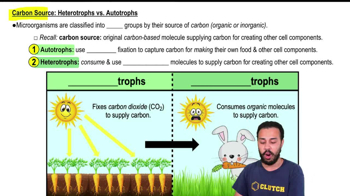
Autotrophs

Autotrophs are organisms that can produce their own food using inorganic substances like carbon dioxide and water, typically through photosynthesis or chemosynthesis. They are primary producers in ecosystems, converting light or chemical energy into organic compounds, which serve as food for themselves and other organisms.
Recommended video:
Guided course
02:59
Carbon Source: Heterotrophs vs. Autotrophs

Heterotrophs

Heterotrophs are organisms that cannot synthesize their own food and rely on consuming other organisms or organic compounds for nutrition. They obtain energy by ingesting autotrophs or other heterotrophs, playing a crucial role in the food chain as consumers, decomposers, or parasites.
Recommended video:
Guided course
02:59
Carbon Source: Heterotrophs vs. Autotrophs

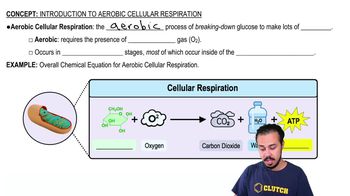
Cellular Respiration

Cellular respiration is a metabolic process that occurs in the cells of both autotrophs and heterotrophs, where organic molecules are broken down to release energy. This process involves glycolysis, the Krebs cycle, and oxidative phosphorylation, primarily occurring in the mitochondria, and is essential for producing ATP, the energy currency of cells.
Recommended video:
Guided course
03:39
Introduction to Cellular Respiration