Pearson+ LogoPearson+ Logo
Ch. 8 - Does Testing Save Lives?
Belk, Maier - Biology: Science for Life 6th Edition
Belk, Maier6th EditionBiology: Science for LifeISBN: 9780135214084Not the one you use?Change textbook
Chapter 8, Problem 8

Among heritable diseases, which genotype can be present in an individual without causing a disease phenotype in that individual?
a. Heterozygous for a dominant disease
b. Homozygous for a dominant disease
c. Heterozygous for recessive disease
d. Homozygous for a recessive disease
e. All of the above

Verified step by step guidance
1
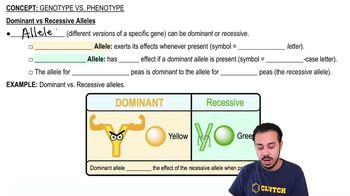
Understand the difference between dominant and recessive inheritance. A dominant disease requires only one copy of the disease-causing allele to express the disease phenotype, while a recessive disease requires two copies of the disease-causing allele to express the disease phenotype.
Analyze the genotype 'heterozygous for a dominant disease.' In this case, the individual has one normal allele and one disease-causing allele. Since the disease is dominant, the presence of one disease-causing allele is enough to express the disease phenotype.
Analyze the genotype 'homozygous for a dominant disease.' Here, the individual has two copies of the disease-causing allele. Since the disease is dominant, this genotype will always result in the disease phenotype.
Analyze the genotype 'heterozygous for a recessive disease.' In this case, the individual has one normal allele and one disease-causing allele. Since the disease is recessive, the presence of one normal allele is sufficient to prevent the disease phenotype, making the individual a carrier without showing symptoms.
Analyze the genotype 'homozygous for a recessive disease.' Here, the individual has two copies of the disease-causing allele. Since the disease is recessive, this genotype will result in the disease phenotype. Therefore, the only genotype that does not cause a disease phenotype is 'heterozygous for a recessive disease.'

Verified video answer for a similar problem:

This video solution was recommended by our tutors as helpful for the problem above.
Video duration:
2m
Was this helpful?

Key Concepts

Here are the essential concepts you must grasp in order to answer the question correctly.

Dominant and Recessive Alleles

In genetics, alleles can be classified as dominant or recessive. A dominant allele expresses its trait even when only one copy is present (heterozygous), while a recessive allele requires two copies (homozygous) to express its trait. Understanding this distinction is crucial for determining how genotypes relate to phenotypes.
Recommended video:
Guided course
03:39
Dominant vs. Recessive Alleles

Heterozygous vs. Homozygous

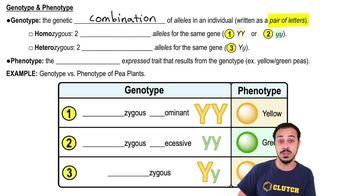
An individual is heterozygous for a gene when they have two different alleles (e.g., one dominant and one recessive), while homozygous individuals have two identical alleles (either both dominant or both recessive). This genetic makeup influences whether a disease phenotype will manifest, particularly in the context of dominant and recessive diseases.
Recommended video:
Guided course
03:39
Dominant vs. Recessive Alleles

Phenotype Expression

Phenotype refers to the observable traits or characteristics of an individual, which result from the interaction of their genotype with the environment. In the case of heritable diseases, certain genotypes may not lead to a disease phenotype due to the presence of dominant alleles or the lack of two recessive alleles, highlighting the complexity of genetic expression.
Recommended video:
Guided course
06:36
Genotype & Phenotype
Related Practice
Textbook Question

Sperm and eggs in humans always ________.

a. Each have two copies of every gene.

b. Each have one copy of every gene.

c. Each contain either all recessive alleles or all dominant alleles.

d. Are genetically identical to all other sperm or eggs produced by that person.

e. Each contain all of the genetic information from their producer.

2
views
Textbook Question

Scientists have recently developed a process by which a skin cell from a human can be triggered to develop into a human heart muscle cell. This is possible because ________.

a. Most cells in the human body contain the genetic instructions for making all types of human cells.

b. A skin cell is produced when all genes in the cell are expressed; turning off some genes in the cell results in a heart cell.

c. Scientists can add new genes to old cells to make them take different forms.

d. A skin cell expresses only recessive alleles, so it can be triggered to produce dominant heart cell alleles.

e. It is easy to mutate the genes in skin cells to produce the alleles required for other cell types.

Textbook Question

What is the physical basis for the independent assortment of alleles into offspring?

a. There are chromosome divisions during gamete production.

b. Homologous chromosome pairs are separated during gamete production.

c. Sperm and eggs are produced by different sexes.

d. Each gene codes for more than one protein.

e. The instruction manual for producing a human is incomplete.

Textbook Question

A woman is a carrier of the X-linked recessive color blindness gene. She has children with a man with normal color vision. Which of the following is true of their offspring?

a. All the males will be color blind.

b. All the females will be carriers.

c. Half the females will be color blind.

d. Half the males will be color blind.

Textbook Question

The pedigree in the figure below illustrates the inheritance of a sex-linked recessive trait. What is the genotype of individual II-5?

a. XHXH

b. XHXh

c. XhXh

d. XHY

e. XhY