Pearson+ LogoPearson+ Logo
Ch. 7 - Fertility
Belk, Maier - Biology: Science for Life 6th Edition
Belk, Maier6th EditionBiology: Science for LifeISBN: 9780135214084Not the one you use?Change textbook
Chapter 7, Problem 2

Add labels to the figure that follows, which illustrates female internal reproductive organs.
Illustration of female internal reproductive organs with labeled structures.

Verified step by step guidance
1
Step 1: Identify the structure at the top center of the image. This is the uterus, which is a muscular organ where a fertilized egg implants and develops during pregnancy.
Step 2: Locate the two oval-shaped structures on either side of the uterus. These are the ovaries, which produce eggs (ova) and hormones such as estrogen and progesterone.
Step 3: Observe the tube-like structures connecting the ovaries to the uterus. These are the fallopian tubes, where fertilization typically occurs.
Step 4: Note the narrow, lower portion of the uterus that connects to the vagina. This is the cervix, which acts as a passageway between the uterus and the vagina.
Step 5: Identify the canal leading downward from the cervix. This is the vagina, which serves as the birth canal and the site for sperm entry during reproduction.

Verified video answer for a similar problem:

This video solution was recommended by our tutors as helpful for the problem above.
Video duration:
1m
Was this helpful?

Key Concepts

Here are the essential concepts you must grasp in order to answer the question correctly.

Female Reproductive Anatomy

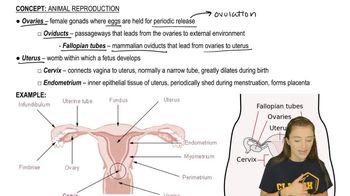
The female reproductive system consists of several key structures, including the ovaries, fallopian tubes, uterus, and vagina. The ovaries produce eggs and hormones, while the fallopian tubes transport eggs from the ovaries to the uterus. Understanding the anatomy is crucial for recognizing how these organs function together in the reproductive process.
Recommended video:
Guided course
07:19
Female Reproductive Anatomy

Ovarian Function

Ovaries are responsible for the production of oocytes (eggs) and the secretion of hormones such as estrogen and progesterone. These hormones regulate the menstrual cycle and are essential for ovulation and maintaining pregnancy. Knowledge of ovarian function is vital for understanding female fertility and reproductive health.
Recommended video:
Guided course
06:04
Functional Groups

Menstrual Cycle

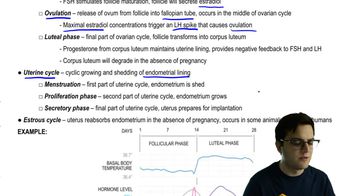
The menstrual cycle is a monthly series of changes in the female reproductive system, primarily regulated by hormones. It includes phases such as the follicular phase, ovulation, and the luteal phase, culminating in menstruation if fertilization does not occur. Familiarity with the menstrual cycle is important for understanding reproductive timing and health.
Recommended video:
Guided course
04:01
Menstrual Cycle