Pearson+ LogoPearson+ Logo
Ch. 3 - Is It Possible to Supplement Your Way to Better Performance and Health?
Belk, Maier - Biology: Science for Life 6th Edition
Belk, Maier6th EditionBiology: Science for LifeISBN: 9780135214084Not the one you use?Change textbook
Chapter 3, Problem 8

A cell that is placed in salty seawater will ________.
a. Take sodium and chloride ions in by diffusion.
b. Move water out of the cell by active transport.
c. Use facilitated diffusion to break apart the sodium and chloride ions.
d. Lose water to the outside of the cell via osmosis.

Verified step by step guidance
1
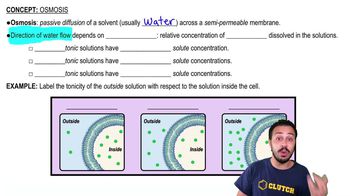
Understand the concept of osmosis: Osmosis is the movement of water molecules across a semipermeable membrane from an area of lower solute concentration to an area of higher solute concentration, aiming to equalize solute concentrations on both sides of the membrane.
Analyze the environment: Salty seawater has a higher solute concentration (salt) compared to the inside of the cell, making it a hypertonic solution relative to the cell's internal environment.
Determine the direction of water movement: In a hypertonic solution, water will move out of the cell to the area of higher solute concentration (the seawater) through osmosis.
Eliminate incorrect options: a) Diffusion of sodium and chloride ions into the cell is unlikely because the cell membrane typically restricts ion movement without specific transport mechanisms. b) Active transport of water out of the cell does not occur because water movement in osmosis is passive. c) Facilitated diffusion does not involve breaking apart ions; it involves the transport of molecules across the membrane with the help of proteins.
Conclude the correct answer: The cell will lose water to the outside environment via osmosis, as water moves out to balance the solute concentration difference.

Verified video answer for a similar problem:

This video solution was recommended by our tutors as helpful for the problem above.
Video duration:
3m
Was this helpful?

Key Concepts

Here are the essential concepts you must grasp in order to answer the question correctly.

Osmosis

Osmosis is the movement of water molecules across a selectively permeable membrane from an area of lower solute concentration to an area of higher solute concentration. In the context of a cell in salty seawater, water will move out of the cell to balance the higher concentration of solutes (salt) outside, leading to cell shrinkage.
Recommended video:

Diffusion

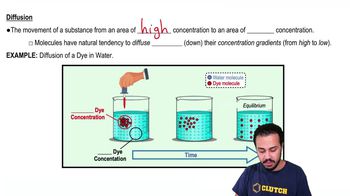
Diffusion is the process by which molecules spread from areas of high concentration to areas of low concentration. In the case of a cell in seawater, sodium and chloride ions may diffuse into the cell if the concentration inside is lower, but this is less relevant when considering the overall osmotic effect of the salty environment.
Recommended video:

Active Transport

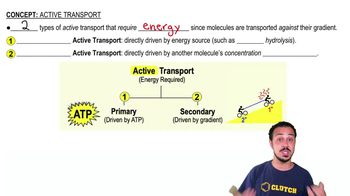
Active transport is the movement of ions or molecules across a cell membrane against their concentration gradient, requiring energy, usually in the form of ATP. While cells can use active transport to maintain ion balance, in the scenario of salty seawater, the primary concern is the passive loss of water through osmosis rather than the active uptake of ions.
Recommended video:
Guided course
02:37
Active Transport