Pearson+ LogoPearson+ Logo
Ch. 16 - Conserving Biodiversity
Belk, Maier - Biology: Science for Life 6th Edition
Belk, Maier6th EditionBiology: Science for LifeISBN: 9780135214084Not the one you use?Change textbook
Chapter 16, Problem 1

Add labels to the figure that follows, which illustrates the interacting factors in a declining population that contribute to the extinction vortex.


Illustration of energy transfer from grass to deer and mountain lions, with biomass labels.

Verified step by step guidance
1
Step 1: Understand the concept of the extinction vortex. It refers to the process by which a declining population becomes increasingly vulnerable to extinction due to interacting factors such as genetic, demographic, and environmental issues.
Step 2: Analyze the first image. It represents a food chain with energy flow. Label the pyramid levels as follows: Grass (primary producers), Grasshoppers (primary consumers), Frog (secondary consumers), Python (tertiary consumers). Add labels for energy flow arrows showing energy lost as heat and decomposers recycling nutrients.
Step 3: Analyze the second image. It illustrates energy transfer in a food chain. Label the energy transfer efficiency: About 10% of energy taken in by the grass is available to the deer, and about 10% of energy taken in by the deer is available to the mountain lion. This follows the 10% rule of energy transfer in ecosystems.
Step 4: Add labels to the biomass bars in the second image. The biomass in the grass population is the largest, followed by the biomass in the deer population, and finally the biomass in the mountain lion population, which is the smallest due to energy loss at each trophic level.
Step 5: Highlight the connection between the two images. Both demonstrate the concept of energy flow and loss in ecosystems, which is a critical factor in population dynamics and can contribute to the extinction vortex if populations decline significantly.

Verified video answer for a similar problem:

This video solution was recommended by our tutors as helpful for the problem above.
Video duration:
4m
Was this helpful?

Key Concepts

Here are the essential concepts you must grasp in order to answer the question correctly.

Trophic Levels

Trophic levels represent the hierarchical positions in a food chain, where each level consists of organisms that share the same function in the ecosystem. In this illustration, grass represents the primary producers, deer are primary consumers, and mountain lions are secondary consumers. Understanding these levels is crucial for analyzing energy transfer and population dynamics within an ecosystem.

Energy Transfer Efficiency

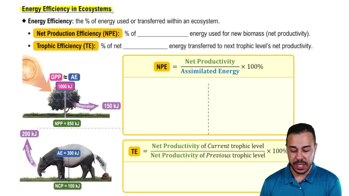
Energy transfer efficiency refers to the proportion of energy that is passed from one trophic level to the next. Typically, only about 10% of the energy from one level is available to the next due to energy loss through metabolic processes and heat. This concept is essential for understanding the biomass and population sizes of different species in an ecosystem, as illustrated in the figure.
Recommended video:
Guided course
06:28
Energy Efficiency in Ecosystems

Extinction Vortex

The extinction vortex is a phenomenon where a population declines to a point where it becomes increasingly vulnerable to extinction due to factors like inbreeding, loss of genetic diversity, and environmental pressures. In the context of the figure, understanding how energy dynamics affect population sizes can help explain how species may enter an extinction vortex, particularly when energy availability is low.
Recommended video:
04:48
Extinctions