Add labels to the figure that follows, which illustrates the interacting factors in a declining population that contribute to the extinction vortex.
Ch. 16 - Conserving Biodiversity

Belk, Maier6th EditionBiology: Science for LifeISBN: 9780135214084Not the one you use?Change textbook
Chapter 16, Problem 3
A mass extinction
a. Is global in scale
b. Affects many different groups of organisms
c. Is caused only by human activity
d. A and B are correct
e. A, B, and C are correct
Verified step by step guidance1
Step 1: Begin by understanding the term 'mass extinction.' A mass extinction refers to a significant and widespread loss of species across the globe within a relatively short geological time frame.
Step 2: Analyze option (a): 'is global in scale.' This is correct because mass extinctions impact ecosystems worldwide, not just localized areas.
Step 3: Analyze option (b): 'affects many different groups of organisms.' This is also correct because mass extinctions typically result in the loss of biodiversity across various taxa, including plants, animals, and microorganisms.
Step 4: Analyze option (c): 'is caused only by human activity.' This is incorrect because mass extinctions have occurred throughout Earth's history due to natural causes such as volcanic eruptions, asteroid impacts, and climate changes. Human activity is a factor in the current biodiversity crisis but not the sole cause of all mass extinctions.
Step 5: Combine the correct options (a and b) and evaluate the answer choices. The correct answer is (d): 'A and B are correct.'

Verified video answer for a similar problem:
This video solution was recommended by our tutors as helpful for the problem above.
Video duration:
4mWas this helpful?
Key Concepts
Here are the essential concepts you must grasp in order to answer the question correctly.
Mass Extinction Events
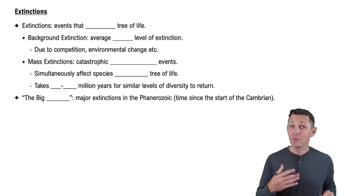
Mass extinction events are significant and rapid decreases in biodiversity on Earth, characterized by the loss of a large number of species across various taxa. These events are typically global in scale and can drastically alter ecosystems and the evolutionary trajectory of life. Historical examples include the Permian-Triassic extinction and the Cretaceous-Paleogene extinction.
Recommended video:
Extinctions
Causes of Mass Extinction
Mass extinctions can be triggered by a variety of factors, including natural phenomena such as volcanic eruptions, asteroid impacts, and climate change. While human activity has accelerated extinction rates in recent times, it is not the sole cause of historical mass extinctions. Understanding these causes helps in assessing the current biodiversity crisis.
Recommended video:
Extinctions
Biodiversity and Ecosystem Impact
Biodiversity refers to the variety of life in a particular habitat or ecosystem, encompassing species diversity, genetic diversity, and ecosystem diversity. Mass extinctions significantly impact biodiversity, leading to the collapse of ecosystems and loss of ecological functions. The interdependence of species means that the loss of one can have cascading effects on others.
Recommended video:
Guided course
Geographic Impact on Communities
Related Practice
Textbook Question
Textbook Question
Compare and contrast the species interactions of mutualism, predation, and competition.
2
views
Textbook Question
Current rates of species extinction appear to be approximately
a. Equal to
b. 10 times lower than
c. 10 times higher than
d. 50 to 100 times higher than
e. 1000 to 10,000 times higher than
38
views
Textbook Question
According to the generalized species-area curve, when habitat is reduced to 50% of its original size, approximately
a. 10%
b. 25%
c. 50%
d. 90%
Textbook Question
Which cause of extinction results from humans' direct use of a species?
a. Overexploitation
b. Habitat fragmentation
c. Pollution
d. Introduction of competitors or predators
e. Global warming