Pearson+ LogoPearson+ Logo
Ch. 16 - Conserving Biodiversity
Belk, Maier - Biology: Science for Life 6th Edition
Belk, Maier6th EditionBiology: Science for LifeISBN: 9780135214084Not the one you use?Change textbook
Chapter 16, Problem 6

Which cause of extinction results from humans' direct use of a species?
a. Overexploitation
b. Habitat fragmentation
c. Pollution
d. Introduction of competitors or predators
e. Global warming

Verified step by step guidance
1
Understand the concept of extinction: Extinction occurs when a species no longer exists. It can be caused by natural factors or human activities.
Review the term 'overexploitation': Overexploitation refers to the excessive use of a species by humans, such as hunting, fishing, or harvesting, leading to a decline in its population.
Compare the options provided: Analyze each option to determine which one directly involves humans using a species. For example, habitat fragmentation involves breaking up ecosystems, pollution involves introducing harmful substances, and global warming involves climate changes, none of which directly involve using a species.
Focus on the correct option: Overexploitation is the only option that directly results from humans' use of a species, such as overfishing or hunting for commercial purposes.
Conclude the reasoning: Based on the analysis, the cause of extinction resulting from humans' direct use of a species is overexploitation.

Verified video answer for a similar problem:

This video solution was recommended by our tutors as helpful for the problem above.
Video duration:
33s
Was this helpful?

Key Concepts

Here are the essential concepts you must grasp in order to answer the question correctly.

Overexploitation

Overexploitation refers to the unsustainable use of natural resources, particularly the excessive hunting, fishing, or harvesting of species. This direct human activity can lead to population declines and, ultimately, extinction if the rate of removal exceeds the species' ability to reproduce. Examples include overfishing of certain fish species and poaching of endangered animals for their parts.
Recommended video:
Guided course
03:23
Habitat Destruction and Degradation

Habitat Fragmentation

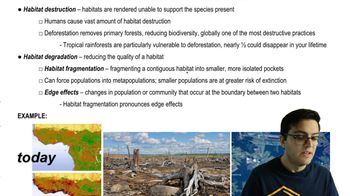
Habitat fragmentation occurs when large, continuous habitats are divided into smaller, isolated patches, often due to human activities like urban development or agriculture. This process can disrupt ecosystems, making it difficult for species to find mates, food, or migrate, which can lead to population declines and increased vulnerability to extinction.
Recommended video:
Guided course
03:23
Habitat Destruction and Degradation

Pollution

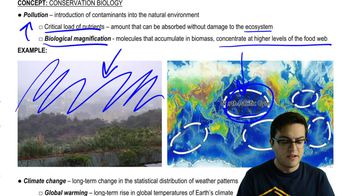
Pollution involves the introduction of harmful substances into the environment, which can adversely affect wildlife and ecosystems. Chemicals, plastics, and waste can contaminate air, water, and soil, leading to health issues in species, habitat degradation, and loss of biodiversity. This can contribute to the decline of species and increase their risk of extinction.
Recommended video:
Guided course
03:36
Pollution and Climate Change
Related Practice
Textbook Question

A mass extinction

a. Is global in scale

b. Affects many different groups of organisms

c. Is caused only by human activity

d. A and B are correct

e. A, B, and C are correct

1
views
Textbook Question

Current rates of species extinction appear to be approximately

a. Equal to

b. 10 times lower than

c. 10 times higher than

d. 50 to 100 times higher than

e. 1000 to 10,000 times higher than

38
views
Textbook Question

According to the generalized species-area curve, when habitat is reduced to 50% of its original size, approximately

a. 10%

b. 25%

c. 50%

d. 90%

Textbook Question

The web of life refers to the

a. Evolutionary relationships among living organisms

b. Connections between species in an ecosystem

c. Complicated nature of genetic variability

d. Flow of information from parent to child

e. Predatory effect of humans on the rest of the natural world

Textbook Question

Which of the following is an example of a mutualistic relationship?

a. Moles catching and eating earthworms from the moles' underground tunnels

b. Cattails and reed canary grass growing together in wetland soils

c. Cleaner fish removing and eating parasites from the teeth of sharks

d. Colorado potato beetles consuming potato plant leaves

e. More than one of the above

Textbook Question

The risks faced by small populations include

a. Erosion of genetic variability through genetic drift

b. Decreased fitness of individuals as a result of inbreeding

c. Increased risk of experiencing natural disasters

d. A and B are correct

e. A, B, and C are correct