Pearson+ LogoPearson+ Logo
Ch. 10 - Genetically Modified Organisms
Belk, Maier - Biology: Science for Life 6th Edition
Belk, Maier6th EditionBiology: Science for LifeISBN: 9780135214084Not the one you use?Change textbook
Chapter 10, Problem 6

Translation results in the production of ________.
a. RNA
b. DNA
c. Protein
d. Individual amino acids
e. Transfer RNA molecules

Verified step by step guidance
1
Understand the process of translation: Translation is the second step of gene expression, where the information encoded in messenger RNA (mRNA) is used to synthesize a polypeptide (protein). This occurs in the ribosome.
Recall the role of mRNA: During translation, mRNA provides the template that specifies the sequence of amino acids in the protein. Each codon (a sequence of three nucleotides) in the mRNA corresponds to a specific amino acid.
Identify the role of transfer RNA (tRNA): tRNA molecules bring the appropriate amino acids to the ribosome based on the codon sequence in the mRNA. They have anticodons that pair with the mRNA codons.
Understand the end product of translation: The ribosome links the amino acids together in the correct sequence to form a polypeptide chain, which folds into a functional protein. Translation does not produce RNA, DNA, or individual amino acids as the final product.
Eliminate incorrect options: RNA and DNA are involved in earlier steps of gene expression (transcription and replication, respectively). Individual amino acids are used as building blocks during translation, but they are not the final product. Transfer RNA molecules assist in translation but are not the end result. The correct answer is protein.

Verified video answer for a similar problem:

This video solution was recommended by our tutors as helpful for the problem above.
Video duration:
2m
Was this helpful?

Key Concepts

Here are the essential concepts you must grasp in order to answer the question correctly.

Translation

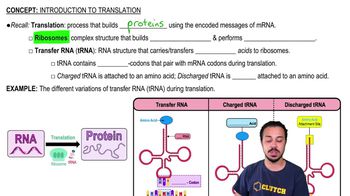
Translation is the biological process in which ribosomes synthesize proteins by decoding the messenger RNA (mRNA) sequence. During this process, the ribosome reads the mRNA codons, and transfer RNA (tRNA) molecules bring the corresponding amino acids to form a polypeptide chain, ultimately folding into a functional protein.
Recommended video:
Guided course
06:12
Introduction to Translation

Role of mRNA

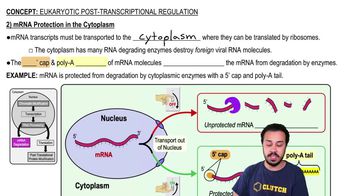
Messenger RNA (mRNA) serves as the template for translation, carrying genetic information from DNA to the ribosome. It is transcribed from DNA and contains codons, which are sequences of three nucleotides that specify particular amino acids. The sequence of codons in mRNA determines the order of amino acids in the resulting protein.
Recommended video:
Guided course
04:08
2) mRNA Protection in the Cytoplasm

Amino Acids and Proteins

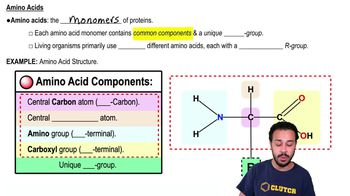
Amino acids are the building blocks of proteins, linked together by peptide bonds to form polypeptides. There are 20 different amino acids, and the specific sequence in which they are arranged determines the structure and function of the protein. Proteins play crucial roles in various biological processes, including catalyzing reactions, providing structural support, and regulating cellular activities.
Recommended video: