Pearson+ LogoPearson+ Logo
Ch. 10 - Genetically Modified Organisms
Belk, Maier - Biology: Science for Life 6th Edition
Belk, Maier6th EditionBiology: Science for LifeISBN: 9780135214084Not the one you use?Change textbook
Chapter 10, Problem 5

During the process of transcription, ________.
a. DNA serves as a template for the synthesis of more DNA.
b. DNA serves as a template for the synthesis of RNA.
c. DNA serves as a template for the synthesis of proteins.
d. RNA serves as a template for the synthesis of proteins.

Verified step by step guidance
1
Understand the process of transcription: Transcription is the process by which genetic information in DNA is copied into RNA. This is the first step in gene expression and occurs in the nucleus of eukaryotic cells.
Identify the role of DNA in transcription: During transcription, a specific segment of DNA (a gene) serves as a template for the synthesis of RNA. This RNA is complementary to the DNA template strand.
Recognize the type of RNA synthesized: The RNA produced during transcription is typically messenger RNA (mRNA), which carries the genetic code from DNA to the ribosome for protein synthesis.
Eliminate incorrect options: a) DNA does not serve as a template for synthesizing more DNA during transcription (this occurs during DNA replication). c) DNA does not directly synthesize proteins. d) RNA does not serve as a template for synthesizing proteins during transcription (this occurs during translation).
Conclude the correct answer: Based on the above steps, the correct description of transcription is that DNA serves as a template for the synthesis of RNA.

Verified video answer for a similar problem:

This video solution was recommended by our tutors as helpful for the problem above.
Video duration:
2m
Was this helpful?

Key Concepts

Here are the essential concepts you must grasp in order to answer the question correctly.

Transcription

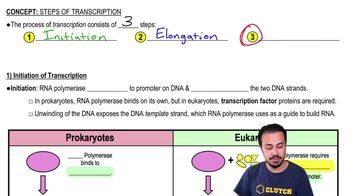
Transcription is the biological process in which the genetic information encoded in DNA is copied into messenger RNA (mRNA). This process occurs in the nucleus of eukaryotic cells and involves the enzyme RNA polymerase, which binds to the DNA template and synthesizes a complementary RNA strand. Transcription is a crucial step in gene expression, allowing the information in genes to be translated into proteins.
Recommended video:
Guided course
04:16
1) Initiation of Transcription

Role of DNA

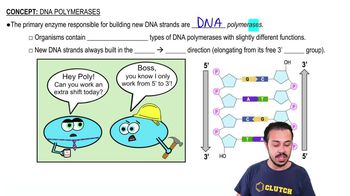
DNA (deoxyribonucleic acid) serves as the hereditary material in living organisms, containing the instructions for the development and functioning of all known life. During transcription, DNA acts as a template to guide the synthesis of RNA, ensuring that the correct sequence of nucleotides is copied. This process is essential for the accurate expression of genes and the production of proteins.
Recommended video:
Guided course
04:01
DNA Polymerases

RNA Synthesis

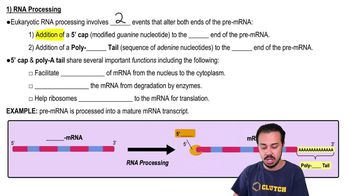
RNA synthesis refers to the process of creating RNA molecules from a DNA template during transcription. The resulting RNA can take various forms, including mRNA, which carries the genetic code from DNA to ribosomes for protein synthesis. This process is vital for translating genetic information into functional proteins, which perform numerous roles in the cell.
Recommended video:
Guided course
04:19
1) RNA Processing