Back
Back
Problem 1
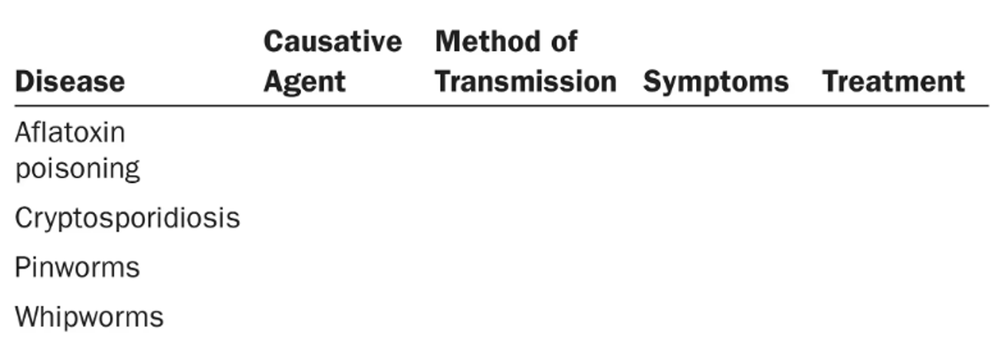
Complete the following table:
Problem 1
All of the following can be transmitted by recreational (i.e., swimming) water sources except
a. Amebic dysentery.
b. Cholera.
c. Giardiasis.
d. Hepatitis B.
e. Salmonellosis.
Problem 2
A patient with nausea, vomiting, and diarrhea within 5 hours after eating most likely has
a. shigellosis.
b. cholera.
c. E. coli gastroenteritis.
d. salmonellosis.
e. staphylococcal food poisoning.
Problem 2
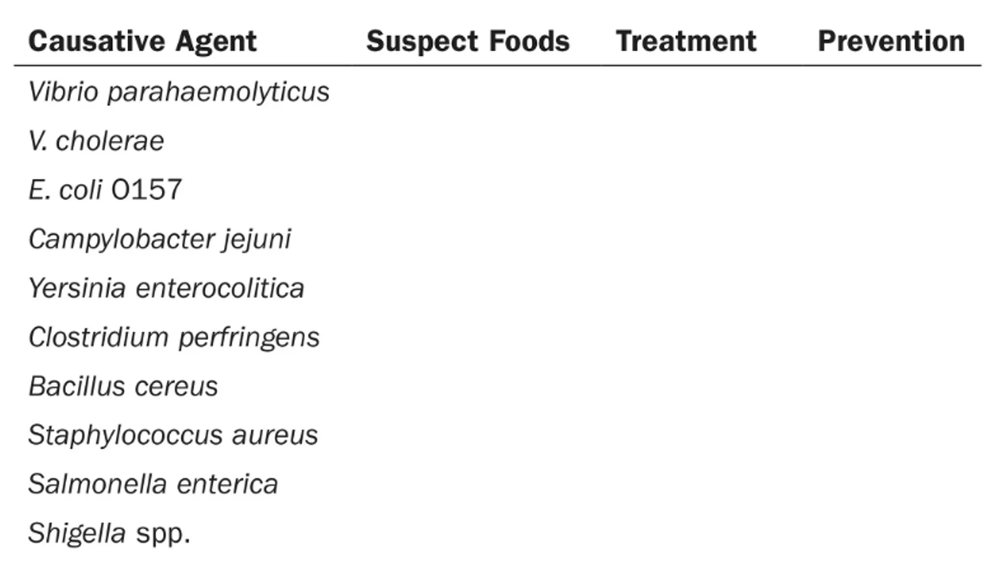
Complete the following table:
Problem 3
Isolation of E. coli from a stool sample is diagnostic proof that the patient has
a. Cholera.
b. E. coli gastroenteritis.
c. Salmonellosis.
d. Typhoid fever.
e. None of the above
Problem 3
Identify the site colonized by the following organisms: E. granulosus, E. vermicularis, Giardia, H. pylori, hepatitis B virus, mumps virus, Rotavirus, Salmonella, Shigella, Streptococcus mutans, Trichinella spiralis, Trichuris.
<IMAGE>
Problem 4
Gastric ulcers are caused by
a. Stomach acid.
b. H. pylori.
c. Spicy food.
d. Acidic food.
e. Stress.
Problem 4
E. coli bacteria are part of the normal microbiota of the intestines and can cause gastroenteritis. Explain why this one species is both beneficial and harmful.
Problem 5
Microscopic examination of a patient’s fecal culture shows comma-shaped bacteria. These bacteria require 2-4% NaCl to grow. The bacteria probably belong to the genus
a. Campylobacter.
b. Escherichia.
c. Salmonella.
d. Shigella.
e. Vibrio.
Problem 5
Define mycotoxin. Give an example of a mycotoxin.
Problem 6
Explain how the following diseases differ and how they are similar: giardiasis, amebic dysentery, cyclosporiasis, and cryptosporidiosis.
Problem 6
A cholera epidemic in Peru had all of the following characteristics. Which one led to the others?
a. Eating raw fish
b. Sewage contamination of water
c. Catching fish in contaminated water
d. Vibrio in fish intestine
e. Including fish intestines with edibles
Problem 7
Differentiate among the following factors of bacterial intoxication and bacterial infection: prerequisite conditions, causative agents, onset, duration of symptoms, and treatment.
Problem 7
Use the following choices to answer the following question:
a. Campylobacter
b. Cryptosporidium
c. Escherichia
d. Salmonella
e. Trichinella
Identification is based on the observation of oocysts in feces.
Problem 8
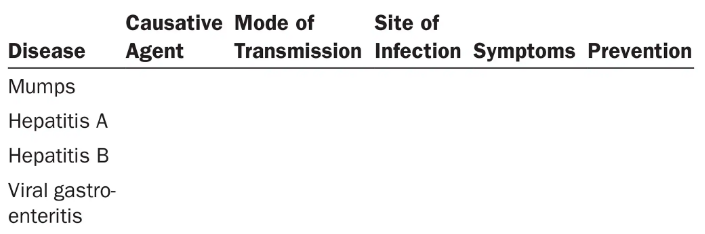
Complete the following table:
Problem 8
Use the following choices to answer the following question:
a. Campylobacter
b. Cryptosporidium
c. Escherichia
d. Salmonella
e. Trichinella
A characteristic disease symptom caused by this microorganism is swelling around the eyes.
Problem 9
Use the following choices to answer the following question:
a. Campylobacter
b. Cryptosporidium
c. Escherichia
d. Salmonella
e. Trichinella
Microscopic observation of a stool sample reveals gram-negative helical cells.
Problem 9
Look at life cycle diagrams for human tapeworm and trichinellosis. Indicate stages in the life cycles that could be easily broken to prevent these diseases.
Problem 10
Use the following choices to answer the following question:
a. Campylobacter
b. Cryptosporidium
c. Escherichia
d. Salmonella
e. Trichinella
This microbe is frequently transmitted to humans via raw eggs.
Problem 10
Cysts of this flagellated organism survive in water; when ingested, the trophozoite grows in the intestine, causing diarrhea.