Back
Back
Problem 1
Why is AIDS more accurately termed a syndrome rather than a mere disease?
Problem 1
Put the number of the type of immune system hypersensitivity in the blank next to each manifestation. Each of the four types may be used more than once or not at all. If the manifestation is not an immune hypersensitivity, put zero in the blank.
1. Acute anaphylaxis
2. Allergic contact dermatitis
3. Systemic lupus erythematosus
4. Allograft rejection
5. AIDS
6. Graft-versus-host disease
7. Milk allergy
8. Rheumatoid arthritis (RA)
9. Asthma
10. Hay fever
I. Type I hypersensitivity
II. Type II hypersensitivity
III. Type III hypersensitivity
IV. Type IV hypersensitivity
0. Not a hypersensitivity
Problem 1
Indicate whether each statement is true or false. If the statement is false, change the underlined word or phrase to make the statement true.
________ Cyclosporine is released by degranulating mast cells.
Problem 1
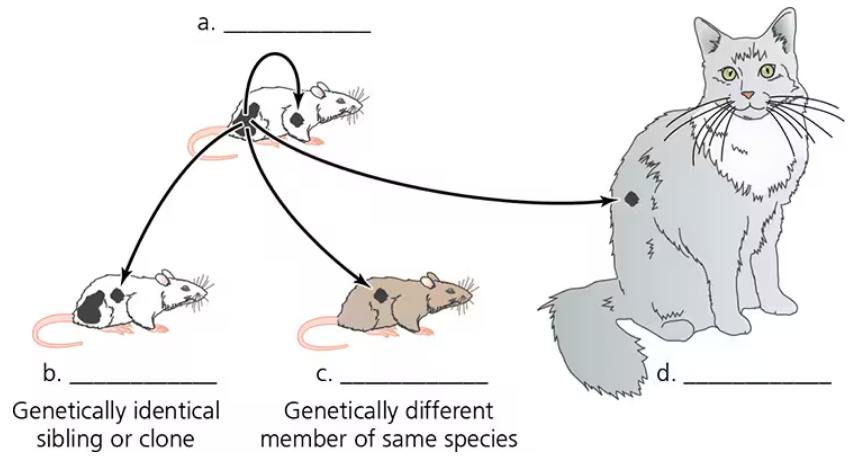
Label the four types of grafts on the accompanying figure.
Problem 1
The immunoglobulin class that mediates type I hypersensitivity is:
a. IgA
b. IgM
c. IgG
d. IgD
e. IgE
Problem 2
The major inflammatory mediator released by degranulating mast cells in type I hypersensitivity is:
a. Immunoglobulin
b. Complement
c. Histamine
d. Interleukin
e. Prostaglandin
Problem 2
Indicate whether each statement is true or false. If the statement is false, change the underlined word or phrase to make the statement true.
_____ Type III hypersensitivity reactions may lead to the development of glomerulonephritis.
Problem 2
Why is a child born to an Rh+ mother not susceptible to Rh-related hemolytic disease of the newborn?
Problem 3
Why is a person who produces a large amount of IgE more likely to experience anaphylactic shock than a person who instead produces a large amount of IgG?
Problem 3
Hemolytic disease of the newborn is caused by antibodies against which major blood group antigen?
a. MHC protein
b. MN antigen
c. ABO antigen
d. Rhesus antigen
e. Type II protein
Problem 3
Indicate whether each statement is true or false. If the statement is false, change the underlined word or phrase to make the statement true.
_____ ABO blood group antigens are found on nucleated cells.
Problem 4
Contrast autografts, isografts, allografts, and xenografts.
Problem 4
Indicate whether each statement is true or false. If the statement is false, change the underlined word or phrase to make the statement true.
______ The tuberculin reaction is a type I hypersensitivity.
Problem 4
Farmer’s lung is a hypersensitivity pneumonitis resulting from:
a. A type I hypersensitivity reaction to grass pollen
b. A type II hypersensitivity to red cells in the lung
c. A type III hypersensitivity to mold spores
d. A type IV hypersensitivity to bacterial antigens
Problem 5
Indicate whether each statement is true or false. If the statement is false, change the underlined word or phrase to make the statement true.
______Graft-versus-host disease can follow a bone marrow isograft.
Problem 5
A positive tuberculin skin test indicates that a patient not immunized against tuberculosis:
a. Is free of tuberculosis
b. Is shedding Mycobacterium
c. Has been exposed to tuberculosis antigens
d. Is susceptible to tuberculosis
e. Is resistant to tuberculosis
Problem 5
Compare and contrast the functions of four classes of immunosuppressive drugs.
Problem 6
Which of the following is an autoimmune disease?
a. A heart attack
b. Acute anaphylaxis
c. Farmer’s lung
d. Graft-versus-host disease
e. Systemic lupus erythematosus
Problem 7
When a surgeon conducts a cardiac bypass operation by transplanting a piece of vein from a patient’s leg to the same patient’s heart, this is a(n):
a. Rejected graft
b. Autograft
c. Allograft
d. Type IV hypersensitivity
e. Cardiograft
Problem 8
A deficiency of both B cells and T cells is most likely a(n):
a. Secondary immunodeficiency
b. Complex immunodeficiency
c. Acquired immunodeficiency
d. Primary immunodeficiency
e. Induced immunodeficiency
Problem 9
Infection with HIV causes __________.
a. Primary immunodeficiency disease
b. Acquired hypersensitivity syndrome
c. Acquired immunodeficiency syndrome
d. Anaphylactic immunodeficiency diseases
e. Combined immunodeficiency diseases
Problem 10
What do medical personnel administer to counteract various type I hypersensitivities?
a. Antihistamine
b. Bronchodilator
c. Corticosteroid
d. Epinephrine
e. All of the above