Pearson+ LogoPearson+ Logo
Ch.6 Carbohydrates Life's Sweet Molecules
Frost - General, Organic and Biological Chemistry 4th Edition
Frost4th EditionGeneral, Organic and Biological ChemistryISBN: 9780134988696Not the one you use?Change textbook
Chapter 3, Problem 64a

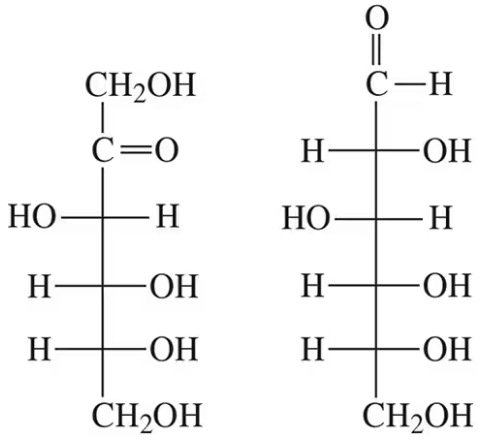
How are the following pairs of carbohydrates, shown in a Fischer projection, related to each other? Are they structural isomers, enantiomers, diastereomers, or epimers?
(a) Fischer projections of two carbohydrate structures for comparison of their relationships.

Verified step by step guidance
1
Step 1: Understand the definitions of the terms provided in the question. Structural isomers have the same molecular formula but different connectivity of atoms. Enantiomers are non-superimposable mirror images. Diastereomers are stereoisomers that are not mirror images. Epimers are diastereomers that differ at only one stereogenic center.
Step 2: Analyze the Fischer projections of the carbohydrates provided in the image. Identify the stereogenic centers (chiral carbons) in each molecule and note their configurations (R or S).
Step 3: Compare the configurations of the stereogenic centers between the two carbohydrates. Determine if all configurations are opposite (indicating enantiomers), if only one stereogenic center differs (indicating epimers), or if multiple centers differ but they are not mirror images (indicating diastereomers).
Step 4: Check if the molecular formulas of the two carbohydrates are identical. If they are not, the molecules are structural isomers. If they are identical, proceed with the stereochemical analysis from Step 3.
Step 5: Based on the comparison, classify the relationship between the two carbohydrates as structural isomers, enantiomers, diastereomers, or epimers. Ensure the reasoning aligns with the definitions provided in Step 1.

Verified video answer for a similar problem:

This video solution was recommended by our tutors as helpful for the problem above.
Video duration:
3m
Was this helpful?

Key Concepts

Here are the essential concepts you must grasp in order to answer the question correctly.

Structural Isomers

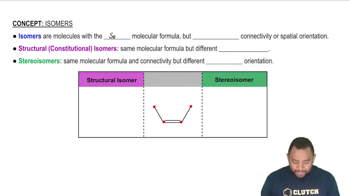
Structural isomers are compounds that have the same molecular formula but differ in the arrangement of atoms. This can include variations in the connectivity of the carbon skeleton or the functional groups attached to it. Understanding structural isomers is crucial for analyzing how different configurations can lead to distinct chemical properties and biological functions.
Recommended video:
Guided course
2:16
Isomers Concept 1

Stereoisomers

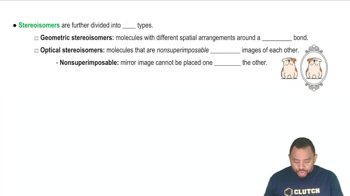
Stereoisomers are compounds that have the same molecular formula and connectivity but differ in the spatial arrangement of atoms. This category includes enantiomers, which are mirror images of each other, and diastereomers, which are not mirror images. Recognizing stereoisomers is essential for understanding the three-dimensional aspects of molecular interactions, particularly in biological systems.
Recommended video:
Guided course
1:56
Stereoisomers Concept 2

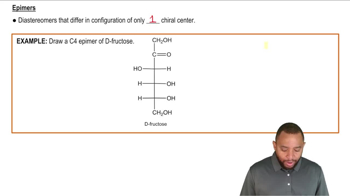
Epimers

Epimers are a specific type of diastereomer that differ in configuration at only one specific carbon atom. This distinction is particularly relevant in carbohydrate chemistry, where small changes in stereochemistry can significantly affect the properties and reactivity of sugars. Identifying epimers helps in understanding the relationships between different sugars and their roles in biological processes.
Recommended video:
Guided course
1:26
D vs L Enantiomers Example 2