Pearson+ LogoPearson+ Logo
Ch.6 Carbohydrates Life's Sweet Molecules
Frost - General, Organic and Biological Chemistry 4th Edition
Frost4th EditionGeneral, Organic and Biological ChemistryISBN: 9780134988696Not the one you use?Change textbook
Chapter 3, Problem 89b

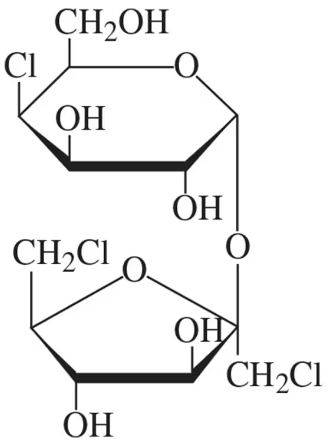
The structure of sucralose, found in the artificial sweetener Splenda, is shown in the figure. It consists of a chlorinated disaccharide made up of galactose and fructose. In its structure shown, (b) identify the type of glycosidic bond present.
Structure of sucralose, a chlorinated disaccharide of galactose and fructose, highlighting its glycosidic bond.

Verified step by step guidance
1
Examine the structure of sucralose provided in the image. It consists of two monosaccharides: galactose and fructose, connected by a glycosidic bond.
Identify the glycosidic bond in the structure. A glycosidic bond is formed between the anomeric carbon of one sugar and a hydroxyl group of another sugar.
In the structure, observe that the bond connects the anomeric carbon of the galactose unit (top monosaccharide) to the oxygen atom of the fructose unit (bottom monosaccharide).
Determine the type of glycosidic bond based on the orientation and position of the linkage. The bond appears to be an α-1,4 glycosidic bond, as the oxygen bridge connects the 1st carbon of galactose to the 4th carbon of fructose.
Conclude that the glycosidic bond in sucralose is an α-1,4 glycosidic bond, which is typical for disaccharides like maltose but modified here due to the chlorination in sucralose.

Verified video answer for a similar problem:

This video solution was recommended by our tutors as helpful for the problem above.
Video duration:
4m
Was this helpful?

Key Concepts

Here are the essential concepts you must grasp in order to answer the question correctly.

Glycosidic Bond

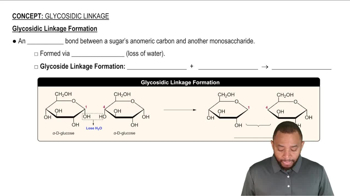
A glycosidic bond is a type of covalent bond that connects a carbohydrate (sugar) molecule to another group, which can also be a carbohydrate. In disaccharides like sucralose, this bond forms between the anomeric carbon of one sugar and a hydroxyl group of another, resulting in a linkage that is crucial for the structure and function of the molecule.
Recommended video:
Guided course
1:44
Glycosidic Linkage Formation Concept 1

Disaccharide Structure

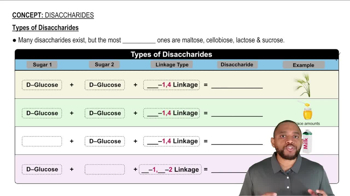
Disaccharides are carbohydrates composed of two monosaccharide units linked by a glycosidic bond. In the case of sucralose, the disaccharide is formed from galactose and fructose. Understanding the arrangement and types of these monosaccharides is essential for analyzing the properties and sweetness of the artificial sweetener.
Recommended video:
Guided course
3:39
Types of Disaccharides Concept 1

Chlorination in Sugars

Chlorination refers to the introduction of chlorine atoms into a molecule, which can significantly alter its chemical properties. In sucralose, chlorination enhances sweetness and stability compared to regular sugars. Recognizing how chlorination affects the structure and function of carbohydrates is important for understanding the unique characteristics of artificial sweeteners.
Recommended video:
Guided course
1:01
Ketoses as Reducing Sugars Example 2