
Textbook Question
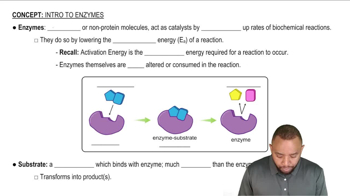
The enzyme sucrase catalyzes the hydrolysis of the disaccharide sucrose but not the disaccharide lactose. Does the induced-fit or lock-and-key model explain the action of sucrase better? Explain.


 Verified step by step guidance
 2:14
2:14
 2:39
2:39 1:02
1:02The enzyme sucrase catalyzes the hydrolysis of the disaccharide sucrose but not the disaccharide lactose. Does the induced-fit or lock-and-key model explain the action of sucrase better? Explain.
What type of interactions between an enzyme and its substrate help to stabilize ES?
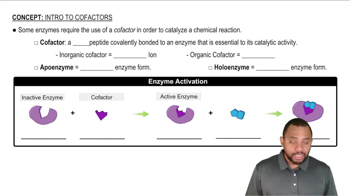
Does each of the following statements describe a simple enzyme (no cofactor or coenzyme necessary), an enzyme that requires a cofactor, or an enzyme that requires a coenzyme?
b. consists of one polypeptide chain in its active form
A substrate is held in the active site of an enzyme by attractive forces between the substrate and the amino acid side chains. For the outlined regions A, B, and C on the following substrate molecule:
b. Could the amino acids serine, lysine, or glutamate be present in the active site? Support your answer.
If each of the following amino acid side chains is present in the active site of an enzyme, indicate whether it would (a) serve a catalytic function, (b) serve to hold the substrate, or (c) both.
a. aspartate
If each of the following amino acid side chains is present in the active site of an enzyme, indicate whether it would (a) serve a catalytic function, (b) serve to hold the substrate, or (c) both.
d. lysine